
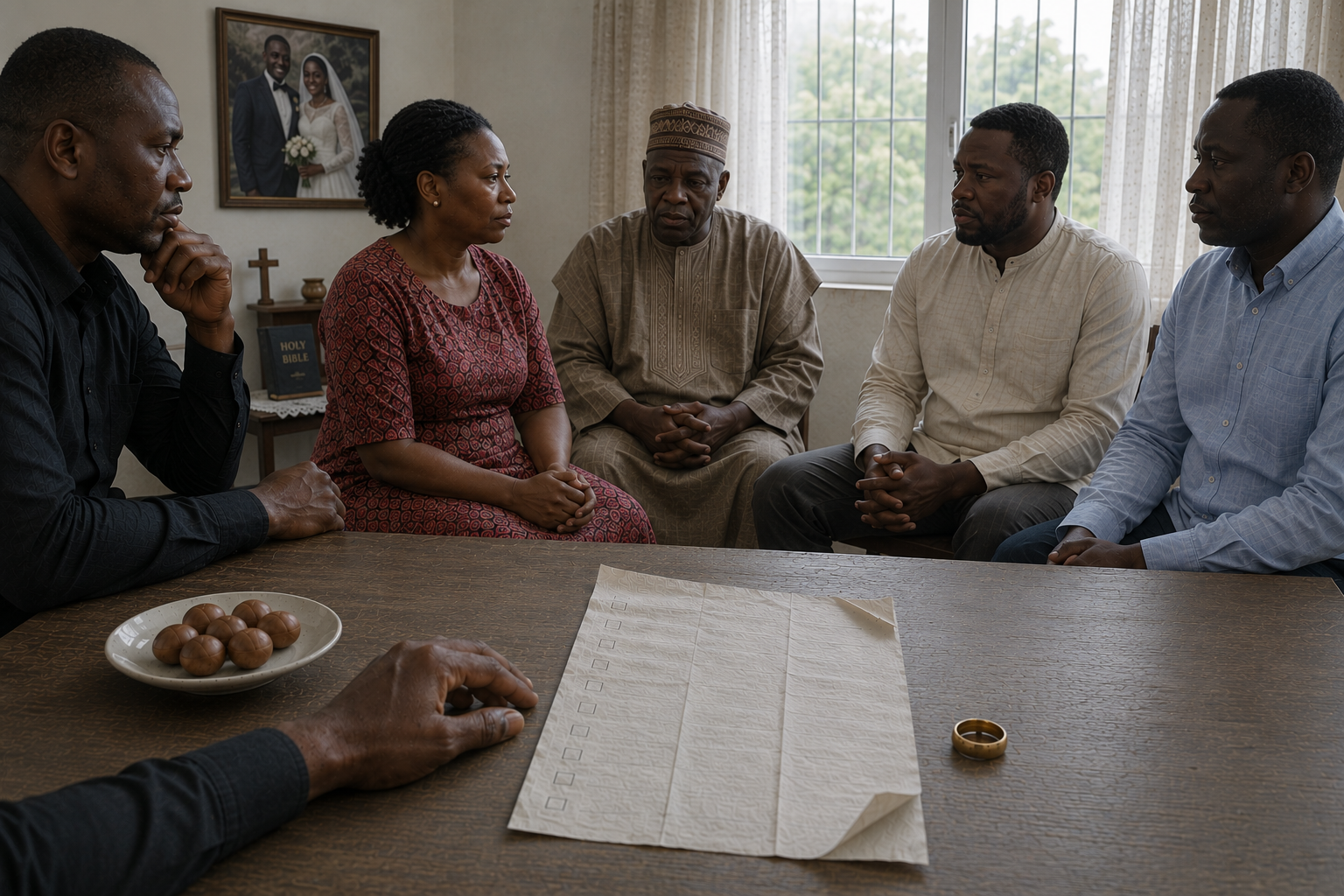
For years, Lazarus Igbegun, a soft-spoken army officer from Kogi State in central Nigeria, believed that his hard work and integrity as a committed Christian would be enough to build a life with the woman he loved. That woman was Gloria, a lady from the southeast state of Imo, whose beauty he believed was unmatched.
Their love was certain, but their future was not. Their relationship eventually took Lazarus to the heart of Gloria’s community for the Ime Ego, the traditional Igbo marriage rite. But the moment the ‘list’ was placed in his hands, a painful realisation hit Lazarus.
“A cold shiver entered my body because I knew that this list was not something I could afford,” he recalls. “I smiled, but deep down, I knew that if not by God’s grace, the marriage was over. As an officer, how much was I making to be able to offset a N2.5m bride price bill?”
The list of items he was expected to present to Gloria’s family was not just symbolic but overwhelming. The document called for live cows, she-goats, dozens of high-end Hollandis wax prints, and cash envelopes for every tier of the extended family—from the Umuada (daughters of the kindred) to the Ndi Ichie (elders).
In the landscape of Nigerian marriage, love is rarely a private matter between two people; it is a negotiation between two forces: culture and cash. That negotiation often takes the form of bride price, reinforced by both tradition and religion.
Bride price is a cultural tradition involving a payment, in the form of money, property, or other wealth, from the groom’s family to the bride’s family at the time of marriage. It serves to legitimize the union, strengthen family bonds, and show respect for the bride’s family. Although the payment in Nigeria is generally symbolic, requirements vary very widely across Nigeria’s more than 250 ethnic groups.
In some ethnic groups, failure to complete bride price rites can complicate claims of legitimacy, with children from the union sometimes considered to belong to the woman’s father. This is the cultural push that insists love—no matter how deep—is legally void without the exchange of the symbolic fee.
As Lazarus held the list in his hand, he no longer saw a bridge but a barricade; in fact, a fundamental distortion of the ‘honour’ the tradition was meant to uphold. He felt that by attaching a multi-million naira price tag to Gloria’s hand in marriage, her family wanted to unjustly enrich themselves through a culture that was supposed to sanctify their love.
And local marriage rites custodians agree, conceding that the modern ‘marriage list,’ such as the one Lazarus received, goes beyond what ancestral customs permit.
“Bride price is not about selling a woman or a get-rich-quick scheme by some families,” explains Okeke Nwafor, a community elder and traditionalist in Imo State. “It is about respect. Historically, it used to be kola nuts and palm wine—these were symbolic gifts. What we see today, where families turn it into a business, is not our tradition.”
The theological compass
But in modern Nigeria, bride price is no longer sustained by culture alone. It is also reinforced through religious interpretations.
“We must understand that religion does not abolish the bride price; it sanctifies it,” says Pastor James Onogwu, a serving minister at Consort House Fellowship in Abuja. “The Bible acknowledges the concept, citing Jacob’s seven years of labor as a form of service for his wives. It establishes that a man must ‘leave and cleave,’ and the bride price is the public, physical evidence of that commitment.”
Among Muslims, the Mahr, as they call it, is not a price tag. It is a divine right that completes the marriage contract.
“In Islam, a marriage is not considered valid (Nikah) without the Mahr. It is a gift from the groom to the bride—a symbol of his ability to provide and her dignity as a woman,” says Sheikh Musa Sani, an Islamic scholar in Kogi State.
Lost love, rebellion, and psychology of ownership
When framed as both a cultural duty and a religious obligation, bride price becomes harder to negotiate—even when the cost is crushing.
Sometimes, the prohibitive financial barrier discourages young men from pursuing formal unions due to the anticipated financial strain in a country battling widespread poverty.
For Lazarus, he painfully returned to Gloria, not with a ring but with a quiet disappointment. “Yes, I just had to call it quits (with Gloria),” he says. “Though it hurts, I believe it’s the best we could do for each other.”
But while women like Gloria have lost love to a culture they did not create, other women chose to stay and fight, sometimes at the cost of their relationship with their own family.
“When my fiancé, Jonathan, showed me the list my family had drafted, the first thing I did was laugh because it was unbelievable,” recalls Ometere Yakubu, a 32-year-old lab scientist from Kogi State.
“The list included two cows, twenty crates of malt, two alligators, and fees for different members of the community. Jonathan is a civil servant. We had already planned a small, modest life. Looking at that paper, I felt like I was being auctioned off to the highest bidder.”
What followed was an altercation that nearly crashed the wedding. Her family felt disappointed that their daughter was going against tradition because she contested the bill. “It was the most painful experience of my life,” Ometere recalls. “I became a ‘rebel’ daughter.”
Eventually, a compromise was reached. The cows and alligators were swapped for a symbolic cash gift, but the scars remained.
For those who manage to pay, the financial burden does not end at the altar. It often reshapes the power dynamics within the marriage.
“When a man exhausts his life savings or takes high-interest loans to ‘afford’ a wife, the power dynamic in the home shifts,” says Ufoma Kennedy, a gender rights advocate at the Nigerian Human Rights Commission. “If a husband believes he has bought his wife, her autonomy is often the first thing to vanish. This ‘commodity mindset’ can lead to domestic possessiveness, where the wife is treated as an asset rather than a partner.
A 2013 study in the Journal of Humanities and Social Science found that “a high bride price has a detrimental effect on marital stability due to the fact that it increases the possibility of domestic violence as men consider women as their property bought at high prices.”
For Lazarus, the list marked the end of a relationship. For others, it is the beginning of a marriage shaped by debt, compromise, or unequal power. In both cases, the question is no longer whether bride price honours love but whether it is slowly pricing it out of reach.