
The song that echoed through the narrow streets of Umuihugba Umuodu Autonomous Community in Nigeria’s southeast city of Owerri was supposed to be sorrowful. But as the drums beat rhythmically on February 6, 2026, the dance steps and chants that followed were rather celebratory.
For those who later watched the video on social media, the soundtrack was even one of horror. The community was happy at the death of 23-year-old Hilary Ikechukwu Emereole, who was accused of being gay. In their eyes, his brutal death was not a tragedy to mourn but a religious and moral victory to be praised.
Mr. Emereole had traveled from the Imo State capital, Owerri, to neighboring Port Harcourt city to meet a man named David Ilo, with whom he had been in communication. According to a petition filed by LGBTQ+ advocates to the Rivers State police command in Port Harcourt, Mr. Emereole was lured to a hotel, where he was assaulted and thrown from a two-story building. He died months later from injuries he sustained.
When his body arrived in his hometown for burial, his community did not mourn his gruesome death; rather, they danced, saying same-sex relationships are against their culture and religion.
But before then, Nigeria’s anti-same-sex marriage law—backed by religious lawmakers—had already condemned him.
The law is often framed as a defense of culture, but its roots and enforcement reveal a deeper force: religion. From the lawmakers who championed it to the communities that uphold it, religious belief has shaped the law and normalized the violence that can follow. That influence is most visible in the law itself.
What the law says
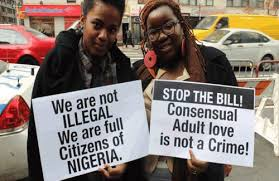
In 2013, Nigeria’s National Assembly passed the Same-Sex Marriage Prohibition bill, which became law after then-President Goodluck Jonathan signed it into law in 2014.
The Act criminalizes same-sex marriages and any form of recognition of same-sex relationships. It prescribes up to 14 years in prison for people engaged in such relationships and up to 10 years for those who aid or abet them.
While lawmakers said the law reflected Nigeria’s cultural values and protected the national interest, critics argue that strong religious beliefs among conservative Christian and Muslim lawmakers also shaped the legislation.
The bill was introduced by Senator Domingo Alaba Obende from Edo, a church deacon who was born Muslim and later converted to Christianity. It soon gained the support of others, including some ex-governors who had introduced Sharia law in parts of northern Nigeria.
Prominent among these legislators was Senator Ahmed Sani Yerima, the former governor of Zamfara State who pioneered the implementation of strict Sharia law in northern Nigeria in 1999.
Yerima was part of a cohort of northern politicians who later moved to the National Assembly after serving as governors during the period when Sharia law was introduced in their states.
Several lawmakers who supported the bill had strong religious credentials or political histories tied to religious legislation.
Observing the pattern of lawmakers who sponsored and passed the anti-gay law, Charles Bassey, a psychologist based in Abuja, says the law isn’t just about politics but a quest to keep the country ‘right with God’ while ignoring equal rights.
“As monotheistic faiths, they attribute supreme authority over human affairs to a single deity. Within this framework, it is believed that individuals may incur divine wrath if they fail to live in accordance with specific tenets,” he says.
Feeding existing sentiments
The law reinforces an existing sentiment in a deeply religious country. From the pulpits of megachurches in southern Nigeria to large mosques in the north, the rhetoric is heavily embraced by religious leaders and followers, framing it as protection of a natural, divine order against a foreign moral contagion.
“In Genesis 2:24, it states that ‘therefore a man shall leave his father and his mother and shall cleave unto his wife: and they shall be one flesh,’ says Pastor Faith Kayode of the Precious Peoples Assembly in Abuja. “This is not a suggestion; it is the divine blueprint. God created Adam and Eve, not Adam and Steve.”
Some Muslim clerics have argued that the penalty the Act stipulates should have been stoning to death.
“The Prophet of Islam said, ‘Whoever you find committing the sin of the people of Lut (Lot), kill them, both the one who does it and the one to whom it is done’—that is, if it is done with consent,” says Mallam Muhammad Jamiu, a Quranic teacher at Kubwa Central Mosque in Abuja. “This hadeeth was narrated by al-Tirmidhi in his Sunan, 1376.”
But not all religious voices support the law. Jide Macaulay, an LGBTQ+-affirming pastor and founder of House of Rainbow, says: “I think that the anti-same-sex marriage bill in Nigeria has gone too far. Nigeria should look at progressive constitutions around the world that are inclusive of sexual minorities.”
The impact of the Act is felt on the ground by queer Nigerians, for whom the convergence of faith and law creates a life of constant fear. The celebration at Mr. Emereole’s funeral reflects how that impact can turn into deadly violence that is publicly endorsed.
While his case was extreme, it is not isolated. There are cases of suspected gay men being arrested and tried in Sharia courts, including 11 men arrested in Bauchi State in 2014 and charged under Sharia.
The 2014 anti-same-sex law does not just ban same-sex marriages; it criminalizes the existence of LGBTQ+ organizations, support groups, and public advocacy. In the northern states operating under Sharia, the stakes are even higher, with the death penalty remaining a potential punishment.
“LGBTQ individuals often find themselves navigating complex internal conflicts as they strive to reconcile their faith with their sexual or gender identity,” says Dahiru Suleiman, a social analyst and lecturer at the Kogi State Polytechnic.
In places like Umuihugba, where death is met with drums instead of mourning, the fusion of Islamic and Christian doctrines into a singular moral compass turns persecution into something that feels not just permissible but righteous.