
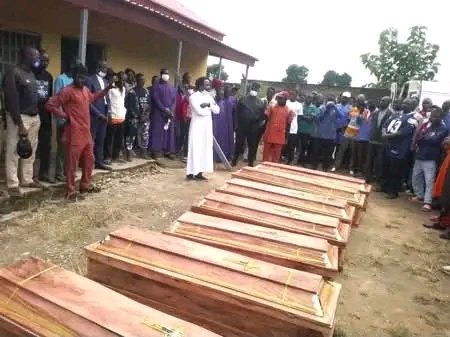
A recent report from a U.S.-based aid organization, Equipping The Persecuted, reveals that in Nigeria, Christians were killed at a rate of one every 86 minutes from January 1 to September 8 2026, primarily in the Middle Belt.
According to the report, over the period, 4,216 Christian deaths were documented in Nigeria, with much of the violence targeting Christian farming communities by organized militant groups motivated by religion.
The report titled “Crisis in the Middle Belt: Religious Persecution and Security Failure in Nigeria” alleged that Fulani militants were responsible for more deaths than Boko Haram and the Islamic State West Africa Province (ISWAP) combined.
While various ethnic and religious communities in Nigeria face violence, the report stresses that attacks on Christians must be recognized as systematically religiously motivated to inform accurate policy responses.
ETP warns that if such incidents are merely characterized as farmer-herder clashes or generalized rural violence, the nuances of mass persecution may be overlooked, mischaracterizing it as an issue of development or law enforcement failure.
The report highlights that while disputes over land and resources do indeed lead to violence, they do not equate to the systematic destruction of communities that is strongly linked to religiously motivated attacks.
ETP points out that the attacks typically involve the burning of churches, targeted killings, abductions, and the enduring displacement of Christian farmers, which cannot solely be attributed to communal disputes.
“Despite existing conflicts related to land use, these factors alone do not fully explain the persistent violence faced by Christian farming groups, which has resulted in the destruction of entire villages and significant long-term displacement.”
Similarly, the report provides a stark account of how communal conflicts are misrepresented, often ignoring the religious dimensions and the implications for public understanding and policy development.
Religious militants are identified as the main threat in regions like Benue, Plateau, and southern Kaduna, with ETP emphasizing that designations like “Fulani-linked actors” refer specifically to organized militant groups and do not suggest collective blame on the Fulani civilian population.
“The severe toll of violence has led to over 5 million Christians being uprooted and more than 600 communities being devastated or deserted,” the report stated.
The report further highlights discrepancies in existing data, demonstrating that Fulani groups are responsible for a disproportionately higher number of deaths compared to Boko Haram and ISWAP, reinforcing the need for a nuanced understanding of violence dynamics.
Importantly, the report underscores that current assistance and responses should go beyond immediate humanitarian relief. It calls for comprehensive strategies including enhanced security measures, credible investigations into violent acts and their perpetrators, as well as improved conditions for displaced populations to return to their homes safely and with dignity.
It stressed the necessity for thorough analyses that include not just Boko Haram and ISWAP, but also Fulani militant networks to fully understand the broader context of violence in the region.