
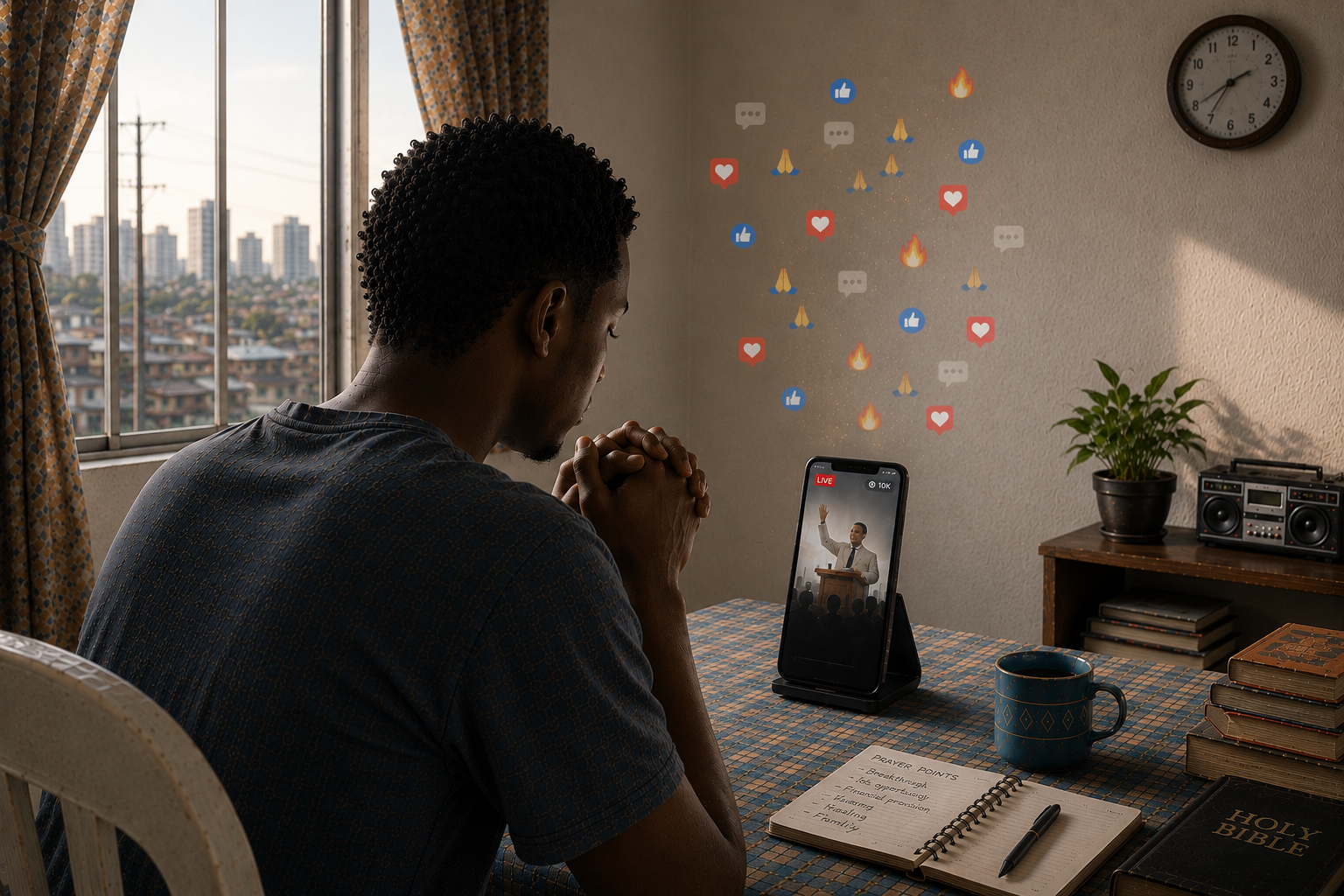
Every 7 a.m. everyday, John Peter sits inside his apartment in Lagos with his phone in hand, hoping for a miracle he believes may finally come through a screen.
“In the face of life’s pressure and having sought a solution in my local church without finding it, I turned to Pastor Jerry Eze’s NSPPD channel.”
Pastor Eze organizes the popular New Season Prophetic Prayers and Declaration [NSPPD], streamed across social media and YouTube. Millions of livestream worshippers send in prayer points as he leads them in ‘prophetic declarations’.
As these digital worshipers chant “What God cannot do does not exist!,” fire emojis and a rushing stream of “Amen” fill their screens.
Across Nigeria, platforms are reshaping worship by turning religious devotions into emotionally engaging, algorithm-driven, and financially sustainable digital experiences.
Although digital worship has been around for at least two decades, it became popular in Nigeria during the COVID-19 pandemic in 2020 when lockdowns forced churches to shut their doors in compliance with the national containment measures.
As churches went online for several months, utilising social media and YouTube streaming for corporate worship, livestreams like the NSPPD became the preferred daily spiritual routine for many young Nigerian Christians. The livestreams have continued and expanded years after the pandemic ended.
Every morning, NSPPD attracts a massive live audience, averaging 282,451 live viewers and 80 million views in 2025 alone. Participants do not just watch. They dance to prayer clips, remix sermons into TikTok duets, and repost testimonies with personal spins. The content, which could sometimes seem optimised for retention, spreads through creator-audience collaboration, not top-down church programs.
Mr. Peter has followed the daily prayer programme for several years, asking God for a breakthrough opportunity. He says he has not received his miracle, but he is hopeful that it would happen someday,
Other popular livestreams include Femi Lazarus’s Prophetic Prayer Contact [PPC] and Michael Orokpo’s Global Prayer Watch. These digital pulpits increasingly substitute for physical gatherings, as millions now join praise dances, prayer marathons, and sermons online.
“Digital tools reach people (physical) churches cannot reach,” says Ekanem Bassey, a pastor at the Plain Truth Ministry in Ikot-Ekpene, Akwa Ibom, “I do feel God’s presence and get rejuvenated each time.”
Sacred or not?
Until the advent of the internet and later social media, worship was entirely physical, creating not just a sense of community among believers, but unity in a cherished sacred purpose. Anything outside in-person fellowship was considered not sacred enough.
Historically, believers have resisted abandoning physical worship even in the midst of persecution, including in places like China where temples, churches, and mosques are sometimes closed and their leaders arrested. There, believers form underground house churches and meet secretly to continue a tradition they believe is holy.
In Nigeria, preachers often warn against the dangers of missing or discontinuing physical worship.
“Don’t be missing the (physical) church services. As you miss the services, you are missing the corporate operation of the Holy Ghost,” warns Pastor Chris Oyakhilome, one of Nigeria’s most popular pastors. “When we meet as a body, there are things that God does, which an individual as yourself just cannot accommodate. That is why He (God) calls the church, the ground and pillar of truth.”
The recent shift to digital worship raises larger questions: How does digital devotion shape people’s perception of sacredness?
While teenagers and young adults relish the convenience and shareability of digital devotion, older people are more conservative, cautioning that it risks diluting worship’s sacred intimacy.
“Physical gatherings carry a deeper connection. When believers gather in one place, the connection feels different. Screens risk turning prayer into watching broadcasts on television,” says Elizabeth Ojoma, whose husband is a pastor at the Power & Wisdom Sanctuary in Kogi State.
Mrs. Ojoma also represents a conservative group that believes algorithms are quietly replacing theology and phones are rivalling physical pews in ways that weaken the authority structures that once defined sacred worship.
Scholars have also raised concerns about how online worship alters religious accountability and community structure. A 2012 study published in the Sage Journal found that “exclusive online worshippers are susceptible to deception and divided loyalty” and that “online worship (could) endangers the offline house fellowship system, which is viewed as the reproductive organ of the local offline church.”
Algorithms and emotional intensity
Besides the virality and accessibility associated with online devotion, monetisation opportunities have also helped sustain digital religious broadcasting.
Recommendation systems on TikTok and YouTube reward frequent posting, emotional intensity, and long viewing sessions. Religious creators, therefore, adapt by using shorter hooks, fire emojis exploding mid-prayer, and marathon live streams that keep viewers glued for hours.
In Nigeria’s faith scene, this means viral pastors craft “scroll-stopping” clips: 15-second declarations over tearful testimonies timed for peak engagement.
“I used to watch hour-long livestreams or recorded sermons every week,” admits Abuja-based Chidi Okeke. “Now, because of my busy schedule, I only watch fiery 30-second to five minute clips on TikTok and YouTube, just fitting them into my busy schedule.”
Due to shrinking attention spans, this pivot has expanded the visibility of preachers on social media farther than ever before, leading to high financial rewards.
Social media platforms such as Facebook and TikTok pay creators between $0.40 and $1.00 per 1,000 views, while YouTube pays between $2 and $30 depending on the content niche. When views and engagements rise into millions, the revenue outcome can be massive.
Playboard, a global platform curating data and ranking YouTube channels, ranks Pastor Jerry Eze’s channel as the most viewed in Nigeria, recording an average of 282,451 viewers per livestream.
According to estimates published by Playboard, in 2024 alone, the channel generated N7.81 billion for Pastor Eze, who is also the founder of Streams of Joy International. Playbook says in 2025, he made N47.7 million each week from YouTube. This is in addition to what he generates from other platforms such as Facebook and TikTok.
While the likes of Pastor Nathaniel Bassey, who organises the online Hallelujah Challenge, chose not to monetize their channels despite having a massive 4.05 million subscribers on YouTube with an average of 1.5 million views per session, the revenue potential of online devotion remains a major incentive for many digital preachers.
A 2025 study titled The Commercialisation of Da’wah: An Islamic Perspective and published in DAOJ, an index of global journals, confirmed this fact.
“The findings reveal that commercialization can positively impact da’wah (a call to Islamic understanding) by expanding its reach and sustainability,” the researchers wrote. But they warn that monetization raises ethical concerns and risks “shifting the essence of da’wah from spiritual goals to materialistic orientations.”
They advised that “clear ethical guidelines are necessary to ensure that digital da’wah practices remain grounded in Islamic values and maintain sincerity in conveying religious teachings.”
But for online worshippers like Mr. Peter, the expectation of a miracle or a sacred connection is more important than any superficial motivation that might be sustaining digital pulpits.
Back in Lagos, he still stares at his screen each morning, typing “Amen” into the livestream chat and hoping that someday, a miracle will finally find him.