As a secular democracy, Nigeria’s constitution ‘guarantees’ every citizen the right to life and freedom of expression. But in parts of Northern Nigeria, a parallel reality exists: a single accusation of blasphemy can override the law in minutes.
Here, blasphemy is not just a legal offense but a trigger for mob justice, empowering ordinary citizens to act as judge, jury, and executioner.
Numerous cases have been recorded where citizens were killed by mobs claiming to defend their faith. Yet, when accusations of blasphemy arise, constitutional protection often collapses within minutes.
Prominent among many cases is that of Deborah Samuel Yakubu, whose only ‘offense’ was a complaint registered via a WhatsApp message.
In May 2022, the 21-year-old student at the Shehu Shagari College of Education in Sokoto State posted a voice note to her class group chat on WhatsApp. She was complaining about the influx of religious posts during exam preparation.
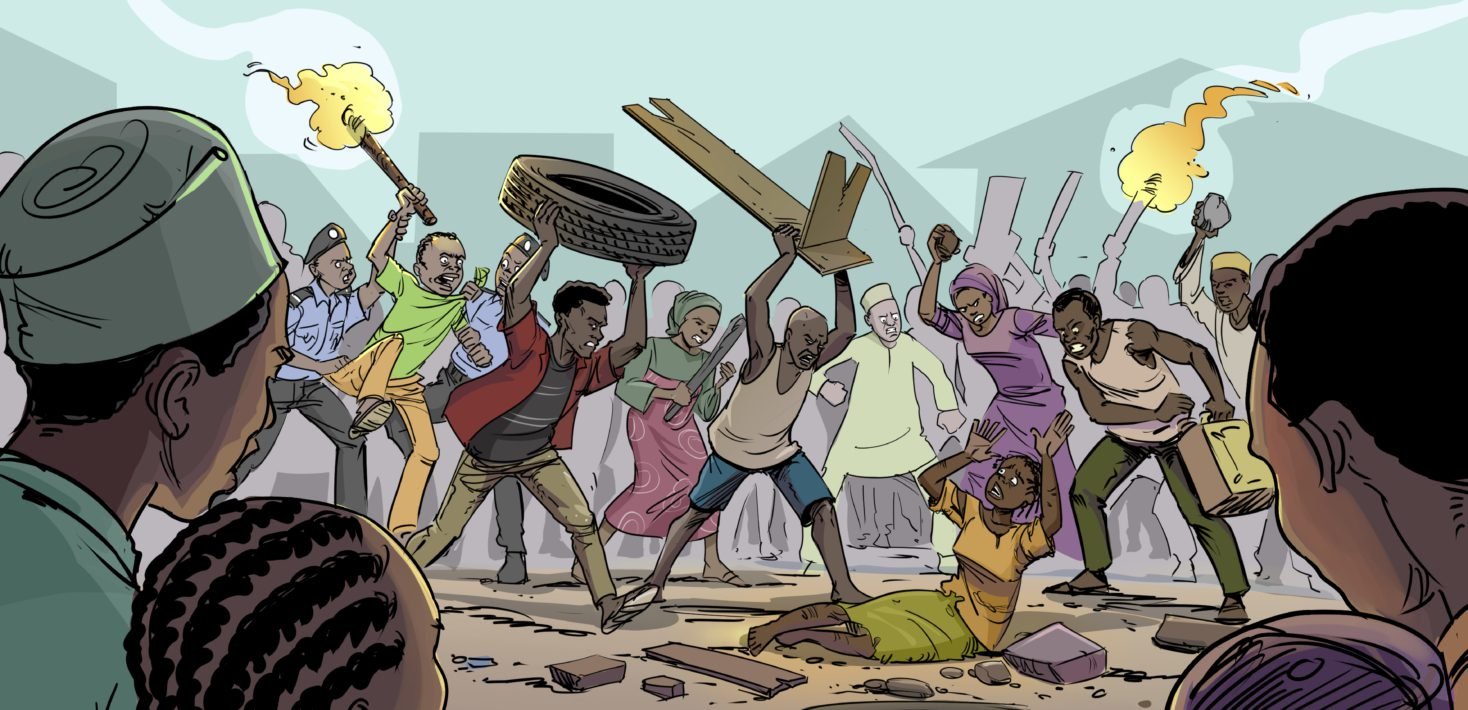
Shortly after, what began as a harmless WhatsApp complaint soon escalated to an accusation of blasphemy. By the end of the day, Ms. Yakubu was dead—stoned and beaten by a mob of her own peers, her body set alight outside the college gate.
Her last words were a plea: “What do you hope to achieve with this?”
Nearly four years after, that question hangs over the entire nation. Like Ms. Yakubu, Usman Buda, a butcher, was stoned to death in 2023 in Sokoto after he was accused of blaspheming Prophet Muhammad during an argument with a trader.
Ms. Yakubu’s and Buda’s deaths are more than isolated tragedies; they echo one of Nigeria’s greatest divides: the friction between a secular constitution that guarantees the right to life and state-level Sharia laws that criminalize blasphemy.
According to data from Amnesty International, between 2012 and 2023 alone, Nigeria recorded 555 mob violence incidents, the majority of them related to blasphemy accusations.
A few times, persons accused of blasphemy had been rescued from the mob and tried in Sharia courts, where most verdicts don’t favour the accused. The case of Yahaya Sharif-Aminu, who was sentenced to death by hanging in 2020 by the Kano State Upper Sharia Court on the accusation of blasphemy, is an example. Mr. Sharif-Aminu later appealed his case to the Supreme Court, which is yet to deliver its judgment.
There have been calls for Sharia-practicing states to amend their harsh penal and Sharia codes, with the regional ECOWAS court ruling that the law violates international human rights obligations and freedom of expression.
In Nigeria’s unclear constitutional situation, accusations of religious insult have evolved into weapons in the hands of mobs descending on the accused. Amidst all these, a question remains: Is Nigeria’s secular democracy truly universal and supreme?
A divided house
Section 38 of the 1999 Constitution as amended guarantees freedom of thought, conscience, and religion. Section 39 protects freedom of expression. But in sections 275–279, the same constitution allows for the establishment of Sharia law in any Muslim-majority state and for personal law matters among Muslims.
Since the nation’s return to democracy, 12 northern states have introduced and adopted Sharia penal codes that run parallel to secular laws. These include Zamfara, Kano, Katsina, and Sokoto, where Deborah was gruesomely killed.
Under these codes, blasphemy is a serious crime, with a death penalty for insulting the Prophet Muhammad.
“We have a situation where the constitution says one thing and state laws say another,” explains Mike Bamidele, a constitutional lawyer with Tahiru Adebayo & Co. Chambers in Abuja. “Technically, the constitution should override any state law inconsistent with it. But in practice, political and religious sensitivities mean these Sharia provisions are rarely challenged by the federal government.”
Because the law is unclear, extremists often take matters into their own hands. When the state is seen as too slow to punish “infidels,” mobs take over.
Some Muslims believe the law of the land is secondary to the law of the faith, and an insult to the Prophet is not merely “free speech” but a provocation that threatens public peace.
“In as much as we know that freedom of speech is entrenched in the Constitution, that doesn’t serve as a means of speaking derogatory words against people’s faith,” explains Fatimah Abdulsalam, a student at Bayero University, Kano (BUK). “It will attract consequences because we hold Allah and His Messenger in such high esteem.”
Judging from this perspective, the state’s enforcement of blasphemy laws is seen not as oppression, but as a necessary mechanism to prevent communal riots by punishing the provocateur. This view complicates any federal attempt to strike the laws down.
However, some Islamic scholars argue that the “consequences” Fatimah speaks of are being hijacked by lawless elements. Professor Usman Dahiru, an Islamic law expert at BUK, explains that while blasphemy is a grave sin in Islam, the faith does not authorize jungle justice.
“The Sharia is a system of order, not chaos,” he says. “Under Islamic jurisprudence, an accusation must be brought before a Qadi (judge). Evidence must be weighed. The accused must have a defense. The unfortunate incident that happened to the young lady was not Sharia (Ms. Yakubu); it was fitna (communal strife). By taking the law into their own hands, the mob committed a sin against the very religion they claimed to defend. Islam still remains a religion of peace.”
Following outcry from international communities, the Sokoto police arrested two suspects, Tidjani Abdulsalam and Aminu Hukunci. However, they were not charged with murder but with “criminal conspiracy and inciting public disturbance,” offenses that carry as little as a two-year jail term.
Still, in early 2023, a Sokoto magistrate court dismissed even these meager charges. The reason? The prosecution failed to show up for multiple hearings. To date, no one has spent a single day in prison for the murder of Deborah.
“This is the fuel for the next fire,” says Onuche Christian, a member of the Peace Ambassador Advocacy Network, from Abuja. “When the state effectively ‘loses the file’ or fails to turn up in court, it sends a clear signal to the next mob: you have a license to kill, provided your victim is an ‘accused’ blasphemer. The state is effectively outsourcing justice to the street to avoid religious blowback.”
Political silence favours the mob
Political reaction to these incidents has been mostly silence. In a nation split roughly between a Muslim North and a Christian South, politicians tread with extreme caution. During the height of Ms. Yakubu’s crisis, high-profile northern politicians initially posted condemnations on social media, only to delete them minutes later after facing a barrage of threats from potential voters.
For example, Atiku Abubakar, then presidential candidate of the Peoples Democratic Party (PDP) in the 2023 general election, initially posted a condemnation to X (formerly Twitter), stating, “No justification for such gruesome murder” and calling for justice.
He deleted the post after followers from northern Nigeria threatened to withdraw their support for his presidential ambition. The fear of losing their support from the most populated part of the country effectively favored the mob.
His action reflected a broader pattern: when politicians must choose between protecting a citizen’s life and securing votes, they often choose electoral survival; hence, they prefer to remain silent rather than speak out or take actions that could jeopardize their political careers.
Until the constitution becomes the final arbiter in practice, the red line of religion may remain a deadly trap for the vulnerable.