
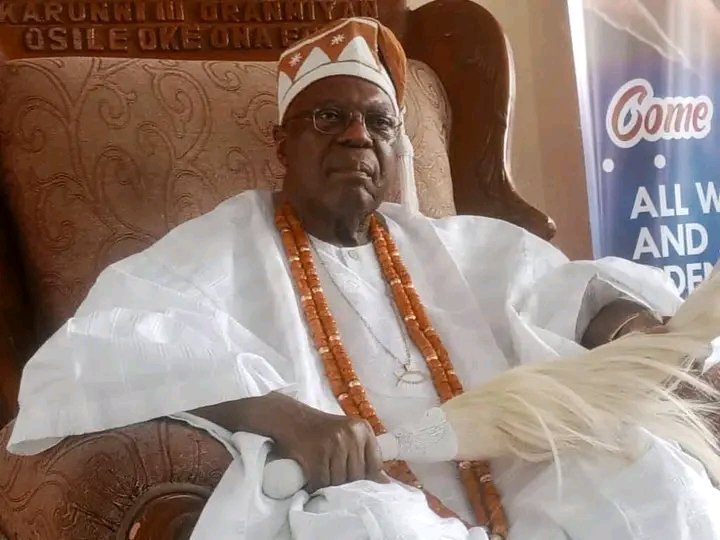
A video showing the Osile of Oke-Ona Egba, Oba Adedapo Adewale Tejuoso, removing his traditional cap during a Christian worship gathering in Abeokuta, Ogun State, has sparked debate over the relationship between religious expression and Yoruba cultural heritage.
The video, which circulated on social media, captured the monarch removing his cap while participating in the King’s day of praise, a gathering of royal fathers to praise the King of Kings.
The event, which held at Bishop’s Court Multipurpose Hall, Onikolobo, Abeokuta, is associated with the Oba Karunwi III Evangelical Movement. It brings the intersection of Christian worship and traditional rulership into public discussion, with Nigerians expressing contrasting views about the significance of the monarch’s gesture.
While some social media users criticised the action as inconsistent with the cultural expectations attached to Yoruba kingship, others defended the monarch’s right to practise his Christian faith.
The debate has also raised questions about the responsibilities of traditional rulers as custodians of cultural heritage and whether their personal religious convictions should determine how they observe royal customs.
Some critics argued that the monarch’s cap represents more than an item of clothing, contending that traditional royal regalia carry cultural significance and should be treated with respect.
According to Punch Newspapers, some social media users questioned the circumstances surrounding the cap’s removal and called for stronger cultural education for prospective monarchs.
An X user identified as Baba Ajisefa questioned whether sufficient respect was being accorded to the institution of traditional rulership. Other commenters called for kingmakers to make traditional education an essential part of the process of selecting and installing monarchs, arguing that candidates should understand the cultural responsibilities associated with their positions.
Some also expressed concern that religious teachings could influence traditional rulers to abandon practices they consider important to Yoruba identity.
However, these reactions reflect the opinions of individual social media users and do not, on their own, establish that the monarch violated a specific customary rule.
Others defended Oba Tejuoso, arguing that removing his cap during Christian worship should not automatically be interpreted as a rejection of Yoruba culture.
Some supporters maintained that a monarch’s religious convictions should be respected, questioning why an act performed during worship should be viewed as disrespectful to the royal institution. Others argued that traditional leadership and Christianity are not necessarily incompatible, noting that a person can maintain a cultural identity while practising a chosen religion.
The disagreement highlights differing interpretations of the obligations attached to traditional rulership, particularly when religious practices appear to conflict with customary expectations.
A longstanding Christian monarch
Oba Tejuoso’s Christian faith predates the latest controversy. In a February 2017 interview with Punch Newspapers, the monarch discussed his Christian convictions and the traditional rites he underwent before ascending the throne.
He explained that he had already become a Christian before his installation and described how he reconciled his faith with the processes associated with becoming king.
His public association with Christianity has also been documented at previous royal celebrations. In a May 2017 report, The Nation reported that the monarch marked the 28th anniversary of his coronation with Christian prayers, gospel music and a prolonged praise session organised by the Oba Karunwi Evangelical Movement.
The report described him as a devout Christian whose celebrations differed from the traditional ceremonies some observers might have expected at a royal anniversary.
These earlier accounts provide context for understanding the latest video: the monarch’s Christian identity is not a new development, even though his gesture during the recent gathering has attracted renewed public attention.
As reactions to the video continue, the central issue remains whether the gesture should be understood primarily as an expression of Christian devotion, a departure from customary expectations or an example of the continuing negotiation between religious identity and cultural tradition.