
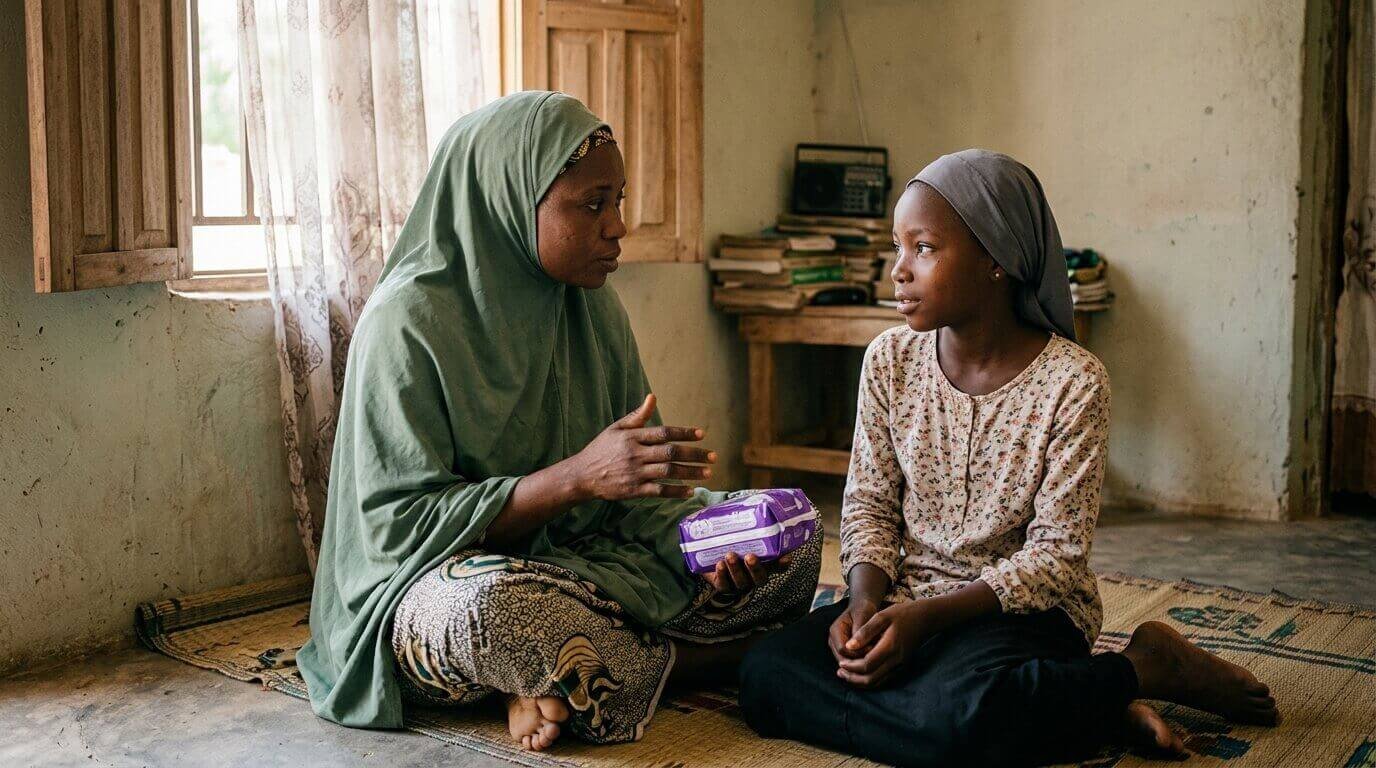
When Aisha’s 11-year-old daughter returned from school one afternoon, she went straight to the bathroom.
A few minutes later, she called her mother.
Aisha found her standing beside the toilet, holding the back of her skirt and looking frightened.
“Ammi, what is happening to me?” the girl asked.
Aisha saw the blood and immediately understood. Her daughter had started menstruating.
But the girl did not know that.
Aisha took her into the bedroom, closed the door and sat beside her.
“That day, I kept telling her not to be afraid. She didn’t know what a period was. She thought something worse was happening to her,” Aisha recalls.
It was a conversation Aisha had expected to have one day. She had simply expected to have it later.
“I thought I still had time,” she says.
Aisha, who lives in the northeastern state of Admawa, is one of many parents in northern Nigeria who believe that conversations about bodily changes should wait until a child is older. But puberty may begin before those conversations take place.
For many families across northeastern Nigeria, conversations between parents and children about menstruation, puberty and sexual health can be difficult to begin. Cultural expectations and religious ideas about modesty and privacy can shape how parents approach such subjects. For some parents, the discomfort comes from how they were raised.
For months, Aisha had noticed changes in her daughter’s body. The girl had also asked questions about why her older cousins sometimes complained of stomach pain (menstrual cramps) and why her mother bought sanitary pads.
Aisha answered only what seemed necessary.
“When she asked me, I told her she would understand when she became older,” she says. “I didn’t think she would need the explanation so soon.”
The conversation parents avoid
Oftentimes, it is not only about postponing conversations about menstruation and sexual health. Even when the time comes, parents often do not talk openly with their children or provide them with comprehensive education about menstruation and sexual health for cultural and religious reasons.
“In our culture, it is not really common for a mother or father to sit down with their children and openly talk about sex, menstruation, or the changes they are going through,” Aisha says.
“We feel shy about those conversations. Talking about it makes us feel like western people, it feels like you are not religious when you do that.”
She now regrets waiting.
“Looking back now, I wish I had talked to her earlier.”
The World Health Organization says menstrual health education includes having timely access to accurate and age-appropriate information about menstruation. It recommends that menstrual-health education be provided to school-aged children before their first period. WHO says this education should also help children know when symptoms such as heavy bleeding or severe pain require health care.
Maryam, a 19 year old secondary school student in Yola, says she first learned about menstruation from a classmate.
“My mother had never really explained it to me. I knew about sanitary pads, but I did not understand why girls used them,” she said.
She said she was initially too shy to ask her mother questions.
“I was afraid that if I asked too many questions, she would think I was doing something bad,” she says. “I was taught about it at home the first day I saw my period.”
The cost of staying silent
The lack of preparation can have consequences beyond the fear of seeing blood for the first time.
The World Health Organization says people without accurate menstrual-health education may feel too embarrassed to ask for help or seek health care and may ignore or accept serious symptoms.
The consequences can also affect education. UNICEF reports that 23% of girls surveyed in Nigeria had missed school in the previous 12 months because of their period. The organisation also reports that many girls were unaware of menstruation before their first cycle.
What does Islam say?
Mallam Usman, an imam in Yola South Local Government Area of Adamawa State, said Islamic teachings on modesty should not leave children ignorant about their bodies.
“Islam teaches modesty, but modesty does not mean that a child should remain ignorant about his or her body,” he says.
According to him, parents have a responsibility to prepare children for puberty while ensuring that the information is appropriate for their age.
“If a child is reaching puberty, the parents have a responsibility to prepare that child for what is coming,” he says.
He refers to Surah An-Nur 24:59, which says that when children reach puberty, they should seek permission as older people do. The verse comes in a passage about privacy within the household.
“But there is a difference between teaching a child what she needs to know and exposing her to things that are not appropriate for her age,” Usman says. “The parent should know the difference.”
Aisha says she did not deliberately keep her daughter uninformed.
“I thought she was still a small girl,” she says.
After her daughter’s first period, Aisha explained what menstruation was and showed her how to use a sanitary pad.
The experience changed how she viewed the conversation she had postponed.
“I don’t want another child to come to me one day and ask why she is bleeding,” she says. “I want her to know before that day comes.”
NOTE: We have hidden the complete identity of Aisha and Marriam to protect their privacy.