
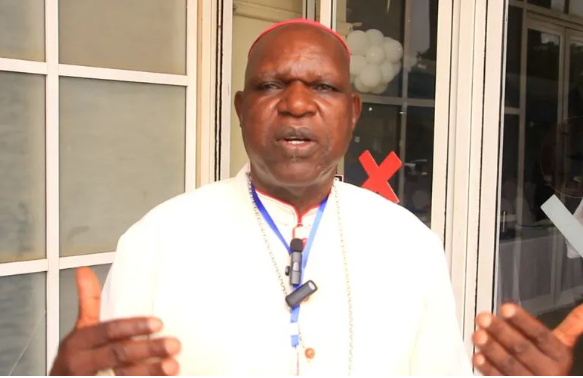
Nigerian Catholic bishop, Sylvester Luka Gopep, has said confronting injustice in the workplace and professional life is an essential part of the Christian mission, urging believers to uphold honesty, fairness and accountability in their various fields of endeavour.
Bishop Gopep, the auxiliary bishop of the Catholic Diocese of Minna, made the call during a celebration marking the centenary of World Mission Sunday, organised by the Pontifical Mission Societies (PMS) in Nigeria on October 18, 2026.
“If there is injustice in your workplace and you are there and you cannot confront it, you have failed as a missionary,” he said in an interview with ACI Africa.
The bishop urged Christians to recognise their workplaces and places of residence as important areas for evangelisation, stressing that the Christian mission extends beyond church activities to everyday conduct and professional responsibilities.
He said believers should demonstrate the values of the Gospel through their occupations, including teaching, medicine, law, business and politics. “The teacher must evangelise the classroom. The doctor must evangelise the hospital. The lawyer must evangelise the practice of law. The businessperson must evangelise the marketplace. The politician must evangelise politics with sincerity, justice, truth, and the common good in public life,” Gopep said.
He warned that corruption, cheating, insincerity and other forms of injustice contradict Christian teachings and undermine the credibility of the Church’s evangelising mission. According to him, Christians must ensure that their professional conduct reflects the values they profess, rather than limiting their faith to religious gatherings.
Bishop Gopep emphasised that missionary responsibility rests on every baptised Catholic, regardless of profession, social standing or financial circumstances. He rejected the notion that missionary work is the exclusive responsibility of priests and members of religious congregations, saying laypeople also have a duty to spread the Gospel through their words and actions.
“The call to be a missionary is not optional. It is mandatory for every Catholic, ordained and unordained. The mission is not for priests and sisters alone,” he said.
The bishop said every person has a God-given purpose and a responsibility to contribute to the well-being of others. “Every human person is born with a mission and for a mission. No human person is an accident. God planned for your coming and existence,” he said.
He also called on priests, religious and lay Catholics to overcome division, jealousy, hatred and personal ambition, stressing that unity is necessary for effective evangelisation. “Without unity, we cannot bear much fruit. In unity, we can bear much fruit,” he said, referring to the 2026 World Mission Sunday theme, One in Christ, United in Mission.
The theme, chosen by Pope Leo XIV, underscores the importance of Christian unity, reconciliation and cooperation in advancing the Church’s missionary work.
At the same event, the national director of the Pontifical Mission Societies in Nigeria, Father Solomon Patrick Zaku, urged Nigerians to contribute to missionary activities and support vocations.
Zaku said Nigeria had benefited from the Universal Solidarity Fund and the generosity of Catholics around the world, adding that Nigerians should also contribute to sustaining missionary work. “As we celebrate the centenary of World Mission Sunday, I want to remind all Nigerians that we are part of this mission. We are not exempt. Since we are receiving, we also need to give because no one is too poor to give. We have something to offer,” he said.
He stressed that the Church’s mission goes beyond preaching to include addressing practical needs such as healthcare, justice, peace and peaceful coexistence. Gopep also encouraged Catholics to support missionary activities through prayer and financial and material contributions, particularly during World Mission Sunday.
He urged priests and members of religious congregations to remain willing to serve wherever the Church sends them, while encouraging laypeople to support missionaries working in difficult areas. “Some go by giving, and some by giving themselves to the mission,” he said.