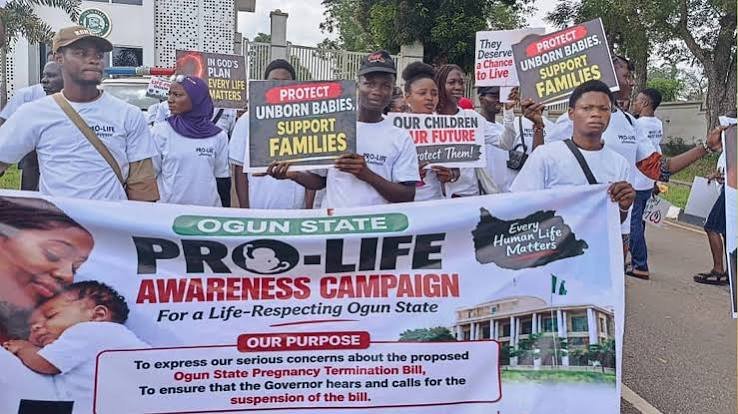
Catholic activists have challenged the Ogun State Safe Termination of Pregnancy Bill, 2026, asking Governor Dapo Abiodun not to sign the legislation over concerns about its implications for unborn children, religious freedom and Nigeria’s existing legal framework.
The activists, operating under CitizenGO, made the appeal in a petition obtained by Religion Journalism Foundation (RJF), calling on the governor to return the legislation to the Ogun State House of Assembly for reconsideration.
The petitioners also urged the state government to strengthen maternity healthcare and provide practical support for women experiencing crisis pregnancies rather than expand access to abortion.
The Ogun State House of Assembly passed the bill, H.B. No. 036/OG/2026, on September 24 and transmitted it to Abiodun for assent. The proposed legislation seeks to reduce maternal morbidity and mortality, promote safe motherhood and establish conditions for the termination of pregnancies on specified grounds.
However, the Catholic activists questioned whether the proposed law was compatible with existing Nigerian legislation governing abortion.
Citing legal opinions obtained during their review of the bill, they argued that its provisions would permit pregnancy termination within the first 12 weeks without requiring a specific medical justification.
They also raised concerns about provisions allowing termination at later stages of pregnancy on grounds including risks to a woman’s physical or mental health.
The petitioners further argued that the legislation could undermine the right of faith-based hospitals and healthcare workers to decline participation in abortion procedures on religious or moral grounds.
They cited Sections 228 to 230 of the Criminal Code, which criminalise various acts associated with unlawfully procuring a miscarriage in southern Nigeria, and questioned whether the state legislature had the constitutional authority to introduce exceptions through the proposed law.
The legal concerns were also raised by Nigerian lawyer Joshua Nwachukwu in a November 5 article published by BusinessDay. He questioned whether the state legislature could enact provisions that conflict with existing federal criminal legislation.
The activists also warned that wider access to abortion could make it easier for perpetrators of sexual abuse to conceal crimes against women and girls.
While opposing the proposed legislation, they acknowledged the need to address maternal deaths, arguing that the state should prioritise skilled birth attendance, emergency obstetric services and support for women facing difficult pregnancies.
“Mothers are saved by skilled care at birth, emergency care when a delivery goes wrong, and real support for a woman in a crisis pregnancy. That is where Ogun State’s effort belongs,” the petition stated.
The campaigners also appealed directly to Abiodun, reminding him of his constitutional responsibility as governor.
“Governor Abiodun swore to uphold the Constitution. He has the power to refuse to sign this bill and send it back to the Assembly. We are not asking him to go beyond his duty. We are asking him to fulfil it,” they said.
The proposed legislation has attracted opposition from other Christian organisations in the state.
In September, the Christian Association of Nigeria (CAN), Ogun State chapter, appealed to the governor not to assent to the bill, arguing that its provisions raised concerns about the sanctity of life and the freedom of healthcare workers to practise according to their religious convictions.
Meanwhile, the state House of Assembly has maintained that the legislation is intended to address maternal health challenges.
During the bill’s second reading in August, Speaker Oludaisi Elemide said the proposed legislation would undergo scrutiny to ensure that its provisions did not conflict with existing laws of the Federal Republic of Nigeria.
The legislation was subsequently considered by the House Committee on Health before lawmakers passed it in September.