
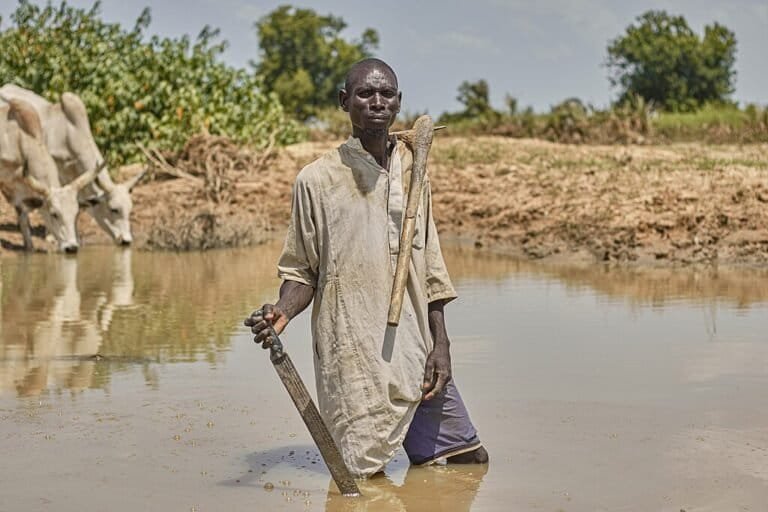
The question rippled through a gathering of skeptical farmers.
“Are you God?” they asked him. With the rains expected in April through October, some folded their arms and laughed while others shook their heads as hoes ploughed the dry earth.
Nana Godwin Agyo had in late March 2023 tried to warn his farming neighbors in Gindin Dorowa community in Nigeria’s north central Taraba State that a dry spell would hit between July and August of the same year.
Agyo is a geographer who works with NGA AgroClimate Tech Service, an organisation that provides climate intelligence for agriculture, business, and policy. His warning was based on forecasts from the Nigerian Meteorological Agency.
But the farmers dismissed him as a doomsayer.
“Keep your scientific calculations in your pocket,” they mocked. “We would pray and seek God’s mercy to avert the crisis.”
When the 40-day flash drought arrived as predicted, crops dried mid-growth, and maize stalks bent under heat.
“I planted early because I believed God would provide rain,” says 46-year-old Yusuf Ahmed, standing beside a patch of withered cassava. “When the drought came, I did not know what to do again.” He said he found himself in debt due to the destruction of his crops.
In Gindin Dorowa, many farmers interpreted the changing weather as divine punishment, rather than evidence of climate change, reflecting a wider societal outlook.
A 2008 BBC and British Council study that gauged how Nigerians view climate change found that: “There is a strong connection between faith and environmental stewardship in Nigeria; many people see changes in the weather as the will of God, and religious leaders emphasise humans’ duty of care to God’s creation.”
The study consisted of 24 focus-group discussions and 31 in-depth interviews with opinion leaders from government, religious institutions, the private sector, the media and civil society, confirming how deeply religious influences shape people’s perspectives on the environment.
But when climate disasters strike and religious explanations rival scientific ones, how do these beliefs shape disaster preparedness and amplify vulnerabilities?
Skepticism from the pulpit
On October 4, 2021, Pastor Chris Oyakhilome, founder of LoveWorld Incorporated (Christ Embassy) and one of Nigeria’s most influential pastors, dismissed climate change as “a hoax” and a “lie” during a global broadcast to his followers.
Comments like this reflect a wider skepticism toward climate science that persists in parts of the country even as climate-related disasters intensify.
In 2023, devastating floods swept through most of the country’s 17 southern states, resulting in losses amounting to N700 billion. Rice and maize farms were wiped off. In September 2024, the northeast state of Borno was submerged in floods not seen in decades, killing 30 people and displacing 400,000 others.
Extreme heat has also become frequent in several northern Nigerian states, including Sokoto, Kano, where temperatures sometimes rise to as high as 40 degrees Celsius. Across Nigeria and the wider African region, similar losses are becoming increasingly common.
According to a 2023 World Meteorological Organisation report, climate change has brought about a 34% decline in agricultural productivity since 1961. The report acknowledges the impact on livelihoods and Nigeria’s food system as crushing. Data from Afreximbank show that Africa’s food import bill jumped from $35 billion in 2023 to $110 billion in 2025, partly due to the effect of climate change on agriculture.
Sermons dismissing climate change from churches and mosques also influence how farmers perceive and adapt to climate-smart agriculture.
“They will hear the forecast, but still say God will intervene,” Agyo says, referring to Gindin Dorowa farmers. “So they take risks they would not take if they trusted the data.”
Although factors like weak extension services, high adaptation costs, weak warning early systems and infrastructure, policy gaps, low literacy, and no national orientation on resilience all contribute to poor farmer preparedness, religious interpretations also shape responses to climate warnings.
“With insufficient knowledge, an incredibly high cost of adaptation and a lack of infrastructure, farmers can only wait the seasons out,” says Agyo.
Balancing faith with data
However, as agricultural losses become frequent and the impact of climate change evident, some religious leaders are trying to correct the narrative, encouraging their farmer communities to follow the science while they pray.
“Prayer does not replace action,” Reverend Philip Ezekiel Agbu, founder of Christian Reform Church-Nigeria in Wukari, Taraba State, tells his congregation. “If you know the rains will delay, you adjust your farming. God gives wisdom, and we must use it.”
At Gindin Dorowa, just before the time the rain was forecasted to return, Agyo went back to the farmers and asked them to prepare for it. When it did, he took advantage of their surprise at the accuracy of the prediction to explain that climate science is mostly correct and that their losses were avoidable.
“I first taught them that Jesus explicitly proved that humans can predict the weather as seen in Matthew 16:3. [With that] we reached a mild consensus,” he says.
For Ahmed, for the first time since he became a farmer, he understood that following climate science has its place while not ignoring prayers.
“That day changed something,” he says, placing his hands on his head in regret. “Now, before I plant, I ask questions. I still pray, but I also listen.”