
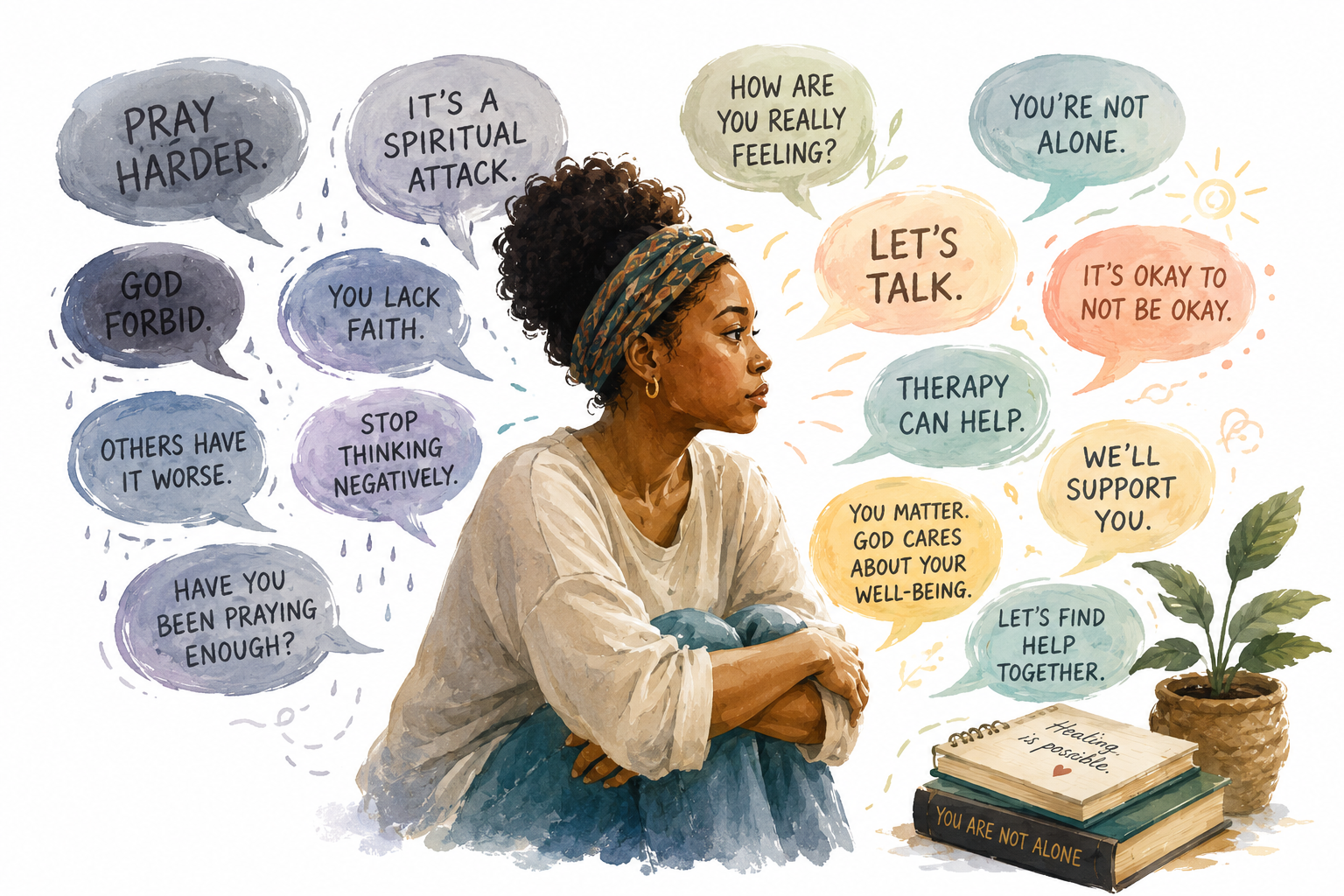
“God forbid!” Judith Bamidele’s parents spat out just before she could finish complaining that her mental health was deteriorating.
Within a short span of time, the Abuja-based 27-year-old member of Christ Embassy had lost her four-year-old relationship and two paying jobs. These experiences made her isolate herself and lose interest in her fashion design side business, friendships, and even her faith.
Inside their small living room, her condition received a verdict: that it is not medical or psychological, but spiritual.
“You just need to pray harder,” her mother said. For months, Judith tried to comply; praying and fasting longer and quoting scriptures. But the heaviness persisted.
“I did not even have faith that what I was trying would work,” she says. “I was weak and exhausted from the emotional strain. I just needed someone to talk to. Someone that would understand the dark feelings that plagued me every day.”
Her story represents a quiet epidemic of mental illness interpreted as spiritual attacks in Nigeria. The World Health Organisation estimates that at least 20% of Nigeria’s 230 million people are struggling with mental health problems. Yet, nearly 80% do not have access to professional support due to stigma, negative attitudes toward mental health, and limited resources.
“1 in every 5 Nigerians is living with a mental health issue. But that is not the real problem. The real issue is people do not talk and everything is termed spiritual. So many people are walking around, functioning, but breaking inside,” explains Lagos-based Kelechi Okoro, a mental health advocate and ambassador for Africa HealthTech Summit.
Mental health experts say spirituality can offer emotional comfort and resilience. But problems set in when faith is treated as a substitute for psychological or medical care.
A 2018 study on spirituality and mental health found that people with higher levels of both spirituality and religiousness reported better quality of life and less anxiety compared to those with lower levels of spirituality and religiousness.
However, another 2022 study involving 101 participants in the UK that explored perceptions of self-harm in the context of evangelical Christian faith communities found that attributing mental health problems to spiritual weakness “may ultimately lead to diminished treatment-seeking and unhelpful interventions which view the individual as at fault for their illness and position them as a passive recipient of spiritual intervention.”
For generations, framing mental health struggles as a lack of faith has worsened individual and community health challenges. The framing can push some young people away from traditional religious spaces when they realise their challenges are more psychological than spiritual.
“I felt like demons were hanging around me. I remember being sad almost all the time, always crying at night, and fighting for my life,” Judith recalls sullenly.
Between prayer and therapy
After leaving home, tired of the constant blame for her circumstances, she confided only in a few close friends who offered her emotional and financial support. Little shows of support like this can go a long way in helping victims recover, experts say.
“Prayer is powerful, but seeking therapy keeps you standing and sane,” Okoro says.
While Judith did not abandon her spirituality, she learned how to combine psychological care with her spirituality for a better outcome.
“I didn’t stop going to church but I took my mental health seriously. I realized my depression wasn’t going to be cured by reading my Bible alone,” she says. “I had to step away from that toxic mindset to actually save my life, get therapy, and deal with the root causes, while I made positive confessions and asked God to send me help.”
The consequences of Nigerians ignoring pragmatic mental health solutions are often severe and worsen over time: worse symptoms, lower functioning, strained relationships, reduced productivity, and in severe cases, disability or death.
As activists like Okoro continue to advocate against negative mental health framing, some religious leaders are now trying to balance their messaging.
At the 2025 CAN Mental Health Summit, the president of the Christian Association of Nigeria, Archbishop Daniel Okoh, urged churches to tackle mental health stigma, provide counseling services and encourage members to seek therapy when needed.
“For too long, discussions about mental health have remained in the shadows of stigma, ignorance, and fear. Many suffer quietly even within our churches struggling with depression, anxiety, trauma, or emotional exhaustion. They are often misunderstood or judged instead of being supported and guided towards healing,” he said.
By replacing dismissive phrases like “spiritual attack” with “mental health challenge,” religious leaders are beginning to frame mental illness in ways that encourage support rather than silence.
They are encouraging their followers to seek professional help without sacrificing their spiritual identities.
For Judith, this shift means not just healing but freedom for herself and millions of other religious Nigerians.
“Faith language used to be my prison,” she says. “Therapy, prayer, and support from friends helped me understand that I was not weak or abandoned. I finally allowed myself to heal.”