
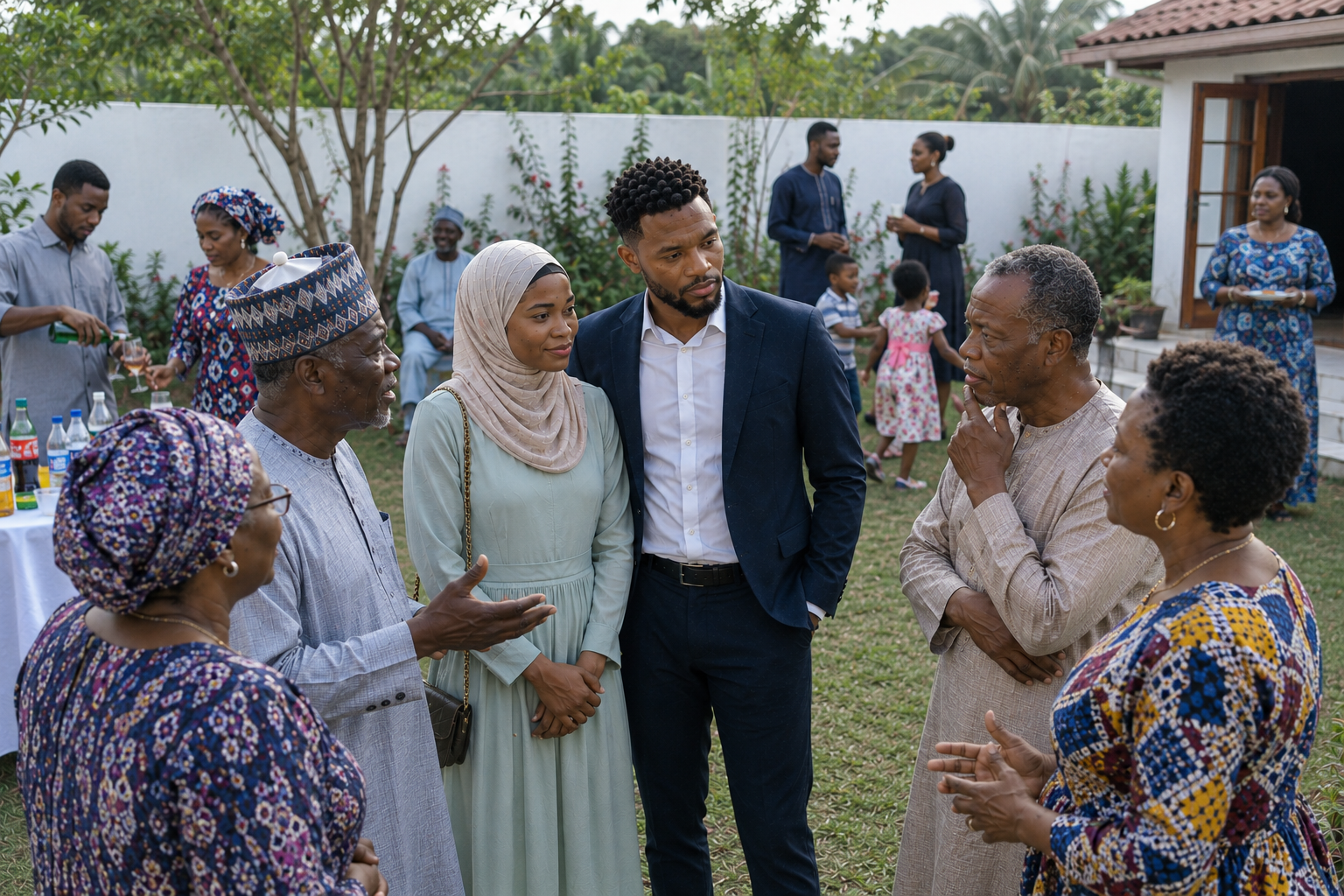
In Victoria’s family in Lagos, interfaith marriage was forbidden. Her pastor father instilled in her early that interfaith romance meant trouble.
“You will lose yourself,” he warned. “You will also lose us.”
So when she brought home a Muslim to introduce to her Christian parents as the man she had fallen in love with, the opposition was vehement.
“They were angry. We nearly gave up on our love, not because our love was fading, but because it felt like we were betraying everyone,” says Victoria (last name withheld for safety), her voice still laden with the weight of those tough days.
At the university, she fell in love with a Muslim student who cared for her and helped her through her academic struggles. He later proposed marriage.
In Nigeria, where religion heavily shapes family life and identity, interfaith marriage can put love on a collision course with family expectations. Some couples win fragile peace through patience and give-and-take. Others face lifelong rejection, tied to deep fears over identity, raising kids, and staying true to God.
Faultlines
Islam and Christianity both frame marriage as a spiritual covenant, not a social contract. Thus, some religious leaders stress shared belief as the foundation of stability within the home.
“No Christian woman should wed a Muslim who will convert her offspring to Islam and prevent them from serving God,” says Philip Olubakin, a pastor at Supernatural Life Church in Abuja.
He describes interfaith marriage as an “unequal spiritual alignment” and insists that the direction of a household begins with the beliefs of both partners. When those beliefs differ, conflict starts early and often shapes the life of the family.
Many Christian parents embody this belief and often kick against their children marrying someone of another faith. But so do many Muslim parents across Nigeria.
“People should live in harmony. That is why Islam guides us to marry within the faith to avoid discord,” says Mallam Abdulazeez Mufiu, an Islamic instructor in Abuja.
However, for some families, the fear surrounding interfaith marriage is shaped not only by doctrine but by painful lived experiences.
In Anyigba, a community in Kogi State, Hannah Danladi, a Christian woman who married a Muslim initially had a happy home until her husband married a second wife, a practice permitted in Islam, which allows men to marry up to four wives.
Although Mrs. Danladi, who believes marriage should be between one man and one woman, stayed in the marriage to protect her children, she says she lives with a constant sense of betrayal.
“I gave him my youth. Now, where do I start?” she laments. “I look at them (the children) when I want to leave. For them, I put up with everything.”
Stories like hers deepen the fears many parents already hold about marrying outside their faith traditions.
“Do you know the conflict in my family, the disownment, the church shunning, that would erupt if I brought a Muslim home? Love can’t survive that war,” says 26-year-old Ada Madumere, a graduate student at the University of Abuja. “I can never date or marry a Muslim.”
Why conflict persists
Interfaith union conflicts arise from unresolved pre-marriage disagreements over power and belief, says Uchechukwu Nwafor, a Lagos-based marriage counselor who has helped over 100 couples navigate such conflicts.
He says common triggers are child-related decisions, arguments over recitation of religious texts like the Quran and Bible, and differences in prayer patterns and schedules, especially during events like Christmas and Easter for Christians and Ramadan and Eid for Muslims.
“Love is never enough. Initial passion may mask these rifts, but problems are inevitable,” he says.
According to Nwafor, to avoid such conflicts couples must set clear priorities early by agreeing on the joint spiritual direction for the home, including how children will be raised when they arrive.
“In the midst of these adjustments, they must establish mutual respect for each other’s practices without constant negotiation. If they cannot, there is no hope for the union to survive,” Mr. Nwafor says.
Yet, opposition to interfaith marriage is not universal in Nigeria. It is common among people of the Yoruba ethnic group. There, religious pluralism is strong and Muslims and Christians inter-marry and live peacefully. A Muslim or Christian could even marry a traditional African worshiper.
According to Olusegun Daramola, a scholar in African spirituality and founder of World Builderr, a platform focused on African spirituality, the prevalence of interfaith marriage among the Yoruba ethnic group stems from a cultural belief that every human came to the world to fulfil a personal destiny. He says the culture emphasises that one must follow a personal religious path that allows him to fulfil that destiny without external influence.
Where patience wins
While Victoria’s family continued to oppose the union, her would-be husband’s family welcomed her without reservation. Encouraged by his parents’ acceptance, her husband-to-be stayed patient, and persistent, offering consistent support to her siblings and proving to her parents that he could make a good son-in-law. Eventually, her parents softened and accepted him.
The initial challenge they faced made the couple realise that they needed to work on achieving harmony in their union through conscious and continued mutual respect.
“We learned from each other,” Victoria says. She joined him during prayer times, and he occasionally read the Bible with her.
In 2018, she made a decision to convert to Islam and completely unite with him spiritually, even though her parents did not support it.
“Now both of our kids are Muslims and I am at ease with it,” she says, adding that she maintains ties with her Christian family and her children go to church too.
For Victoria, their relationship did not survive because their differences disappeared. It survived because both families, after years of resistance, finally made room for understanding, even if the differences remain.