
The screen opens with the golden light of a south-western Nigerian sunset. The 2025 thriller The Herd on Netflix begins with a scene many viewers find painfully familiar.
A newly married couple, still buzzing on their road trip, are ambushed by armed kidnappers, also known as bandits. As they are dragged into the bush, midway, the bandits stop for salat (Islamic prayer). They spread their mats and begin to pray while their prey wallows in pain.
In another scene, a respected priest (played by Lateef Adedimeji) walks through his church. He isn’t preparing a sermon. He’s arranging a human organ deal, with victims hidden in a freezer near the altar.
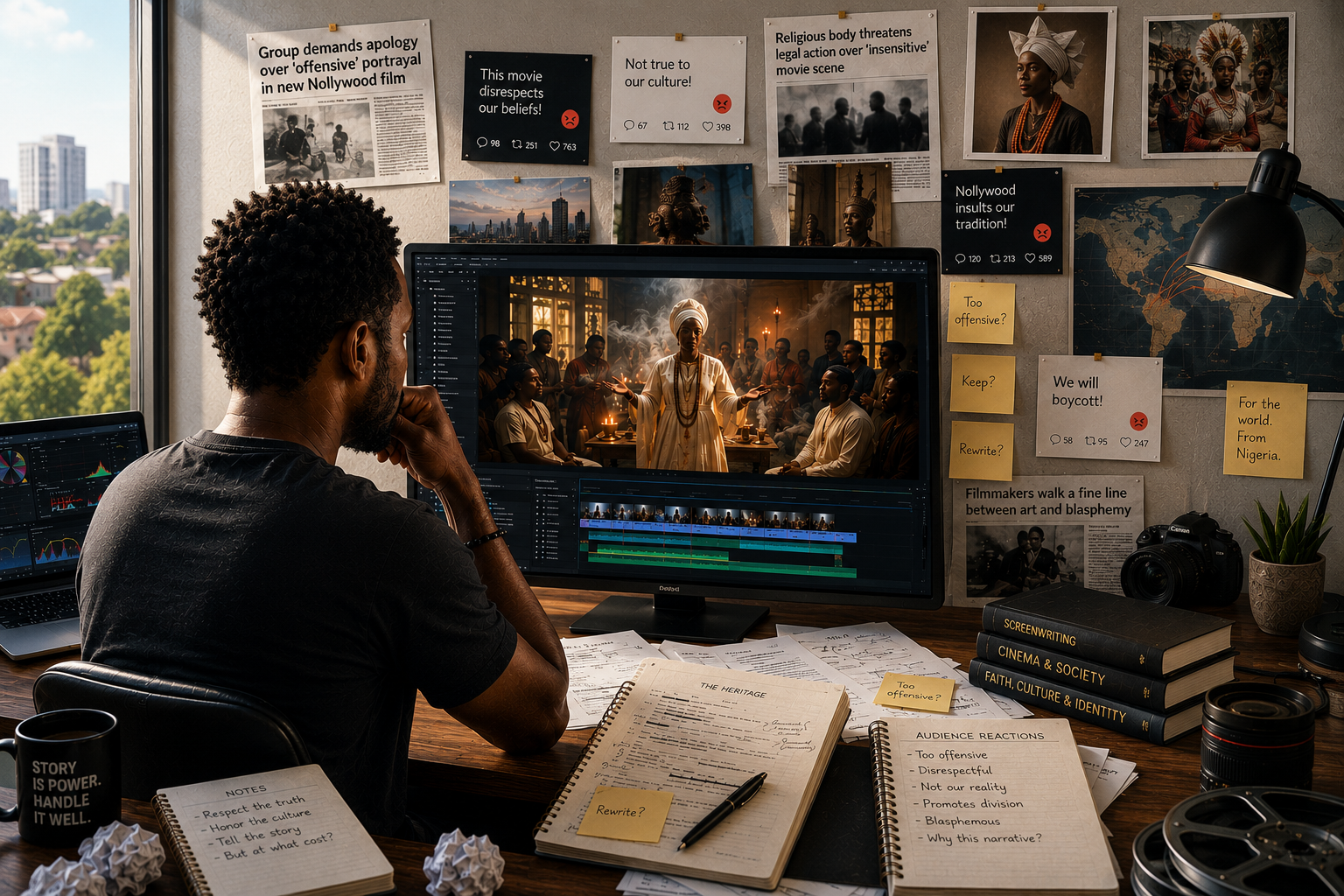
The online reaction was instant. On X (formerly Twitter), conversations quickly pivoted from the cinematography to fierce debates about the film’s message. Critics accused the director of weaponizing religious and ethnic stereotypes. It was not just a movie review anymore; it was a nationwide argument.
In Nigeria, religion is hardly treated as private belief alone. It intersects with ethnicity, morality, political alignment, and communal survival. That is why cinematic portrayals of faith are often interpreted as cultural and ideological attacks, and not just artistic choices.
In late 2025, the Christian Association of Nigeria (CAN) demanded an apology over Ini Edo’s ‘A Very Dirty Christmas,’ arguing the title trivialized Christ’s birth. Before that, the Isale-Eko Descendants Union dragged the creators of Gangs of Lagos to court over its depiction of the sacred Eyo Festival. As these institutions and their followers increasingly resist such portrayals, experts say their backlash has become a form of informal censorship.
“The real censorship isn’t always from the government,” says Akuh Benjamin, a media lawyer based in Lagos. “It’s social censorship. It’s the threat of boycotts that makes filmmakers second-guess themselves before they even shoot a scene.”
As reviewers debate the meanings behind The Herd, it signals something more than controversy: a moment of reckoning.
Nollywood, Nigeria’s movie industry, is increasingly becoming a space where conversations about faith, identity, and coexistence are not only reflected but contested, negotiated, and reimagined. By questioning religious authority and identity politics, Nigeria’s contemporary filmmakers are caught between artistic provocation and a society that views its religious symbols as untouchable.
Challenging old plots
If you grew up witnessing the 90s Nollywood, the pattern was predictable. The climax almost always positioned spiritual forces as the ultimate explanation for almost all human suffering. This was evident in ‘Living in Bondage,” a 1992 movie where Kenneth Nnebue, the producer, showed a man sacrificing his wife for wealth, only to be haunted by her ghost.
That movie helped popularise an era of Nollywood storytelling where spiritual warfare and miraculous deliverance became dominant narrative themes. This trend was then cemented by Mike Bamiloye’s Mount Zion films, which essentially turned television into an auxiliary pulpit.
However, the modern era of Nollywood filmmaking focuses on realism, social critique and psychological depth. This new wave uses faith-based narratives to dismantle these very protections and ask difficult questions like: “Is the person behind the pulpit a true spiritual guide or a political middleman?”
By portraying religious leaders as organ traffickers or corrupt power brokers, films like The Herd challenge the “touch not my anointed” culture that has historically shielded religious institutions from accountability.
There has also been a shift in gender norms. Where traditional Nollywood often casts women as the primary victims of “spiritual attacks” or the desperate seekers of miracles, modern narratives are repositioning them. In films exploring syncretic Yoruba spirituality, for example, women are increasingly portrayed as custodians of ancient wisdom rather than just “witches” to be exorcised.
Films like C.J. Obasi’s Mami Wata (2023) position women as the spiritual backbone of their communities—intermediaries between the people and the divine.
In Kunle Afolayan’s Anikulapo, the supernatural forces at play are deeply intertwined with female presence and ancient lore. This shift does more than change the plot. It challenges the patriarchal structure of both the church and the traditional shrine.
Yet, this reclamation of identity and power rarely goes unchallenged in a society as deeply conservative as Nigeria. As filmmakers move from miracle stories to these more provocative portrayals of authority and ancient wisdom, religious and cultural institutions are increasingly pushing back.
Fictionalized faith
For filmmakers, the pressure is no longer only legal. What matters is also what the audience is willing to tolerate. This shift has forced directors into a difficult balancing act between their creative freedom and public scrutiny.
“Nigeria exists in a really unique legal grey area,” explains Benjamin, the media lawyer in Lagos, pointing out that while the constitution guarantees freedom of expression, the national censorship board can ban films deemed likely to offend religious sensibilities.
Within this corridor, filmmakers are wary of how they weave religion into plot and character. So they try a defensive posture: to mirror Nigeria’s soul without sparking a firestorm. This has led to what some filmmakers call ‘fictionalized faith’.
“Nollywood has reached that stage where we try to shy away from stories that deal with religion for fear of criticism and backlash,” explains Victor Eyike, an independent filmmaker in Lagos, adding that the industry is entering an era of narrative neutrality.
Instead of naming a specific sect in plots, filmmakers now construct mystical and fictional religions, a creative distancing that allows for a critique of hypocrisy and human nature without the legal or social risks of misinterpreting a living faith.
When a script must touch on the real world, the producer insists that the only defense is accuracy.
“Go to the custodian of that particular religion and get your facts right,” Eyike advises on how to bridge the gap between fiction and reality as a survival mechanism.
However, not everyone agrees with Eyike’s perspective of playing it safe. Scholars like Samson Igbabul, a theater arts lecturer at the Kogi State University, says “sanitizing” films does a disservice to the culture.
“When a filmmaker incorporates a shrine or a prayer session, they aren’t just adding themes. They are engaging in cultural documentation. To strip a film of these elements for the sake of safety is to produce a story without a soul,” he says.
Regarding pushbacks from audiences and religious bodies, Igbabul says it is often a symptom of a society that is uncomfortable with its own reflection.
“As academics, we argue that the filmmaker’s role is to be a provocateur. If a religious group complains, your defense should be your research.”
This perspective views pushback as a sign of a story’s relevance. It sees the filmmaker not as a creator of safe fantasies but as a custodian of cultural documentation.
Exporting identity
As Nollywood matures, its narratives are no longer confined to local circuits; they have become a primary export on global streaming platforms. As the world’s second largest film industry by volume, Nollywood wields enormous cultural influence beyond Nigeria, challenging filmmakers to serve narratives that reflect the audiences’ lived realities.
“We are repositioning our storytelling because we understand that a story told in Lagos today will travel across the world tomorrow. The larger the audience, the greater the accountability to society,” says Vande Akah, an indigenous film producer in Benue State
In essence, the modern Nigerian producer is no longer just a filmmaker; they are a brand manager for a national identity. Whether religious or secular, these stories are now being packaged with a global consciousness, ensuring that as Nollywood’s influence grows, its accuracy keeps pace with its ambition.
Even as the industry turns its camera toward Nigeria’s sacred institutions, the pushback is no longer a sign of failure but a signal of relevance. It forces the audience to ask, “When faith becomes central to public identity, can it ever avoid criticism?”