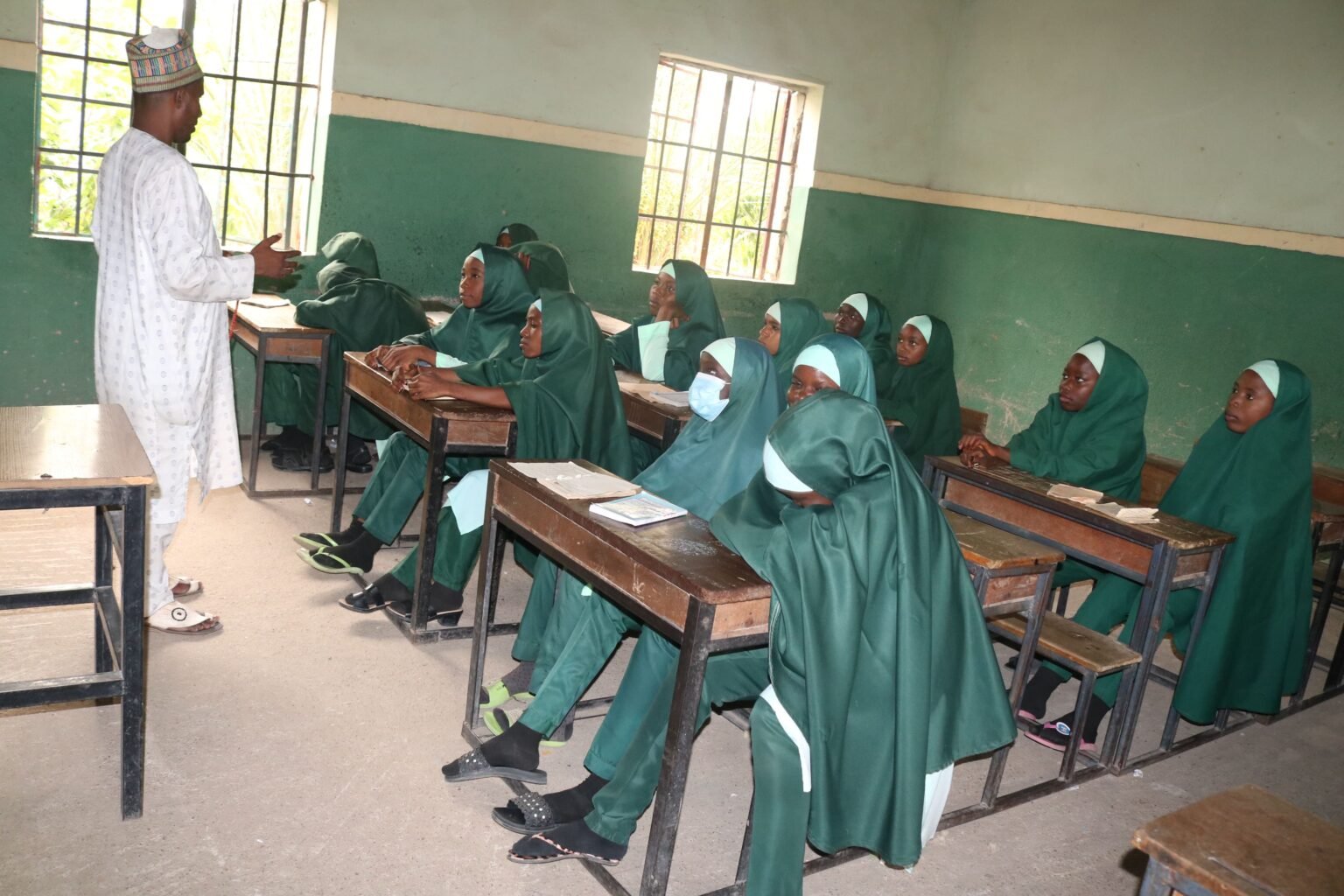
Thirteen-year-old Amina sits at a desk in her classroom, where the morning sun hits her open biology textbook. Her eyes are fixed on the pages of her Qur’an, studying Surah Al-A’raf, a chapter detailing the creation story.
“This is what I do every day,” she says. “I have to learn at least one verse of the Qur’an because when my Islamic teacher comes, he will definitely ask me questions. I don’t want to fail.”
For Amina, and millions like her in Nigeria, education does not exist in a secular vacuum. It is a tapestry where the periodic table and the parables of the Bible or verses of the Qur’an are woven into the same fabric.
This fusion is a structural pillar of the national curriculum and has long shaped the Nigerian educational landscape.
The infusion of religious studies into Nigeria’s school system stems from the 19th century, when both Christian and Muslim missionaries used it as a way to promote literacy alongside moral training.
Although missionaries were the architects of religious studies, the National Policy on Education categorized these studies under the ‘Religion and National Values’ theme, making it a mandatory structural pillar rather than a classroom elective.
While the policy is handed down from the federal level, it is the educators who breathe life into it. For these instructors, the ‘sacred syllabus’ is a tool to instill discipline, morals, and a sense of responsibility in students—which they believe a purely Western model of schooling doesn’t guarantee.
“We are not just producing scientists; we are building the nation by instilling our core values,” says Zakari Lawal, a Quranic teacher in Kogi State, Nigeria. “If you strip a child of their religious context, you’re asking them to learn in a language that doesn’t speak to their soul. In the end, we don’t want scientists who are technically brilliant but morally irresponsible, those who feel no accountability to a sovereign being, to God.”
But a student’s world requires a different kind of oversight, one that addresses the emotional weight of carrying two worlds at once, argues Funke Adeyemi, a school counselor based in Ibadan who sees this reflected in how students handle the pressures of schooling.
“Religious content shapes their interreligious attitudes. When we teach religious literacy—learning about the ethics of different faiths—it’s a window. But if it becomes too insular, it can build walls. The goal is to move from ‘I am right’ to ‘We both value justice,'” she says.
The debate
But on a wider view, there is the fear that faith in the classroom clouds the pursuit of an empirical worldview. Experts say such integration is a step backward for a nation aiming for global competitiveness.
“If we prioritize religious instruction, we may inadvertently tell the child that faith is more important than the empirical evidence they need to solve technical problems,” argues Afolabi Micheal, an ed-tech consultant in Abuja. “When we allow (faith) to dictate the curriculum, we risk compromising objective truth. A secular curriculum ensures that every child, regardless of their parents’ beliefs, has an equal shot at an unbiased education.”
The debate eventually lands on the desk of policy experts like Prof. Musa Haruna, executive chairman of the Jigawa State Universal Basic Education Board (SUBEB). He bridges the gap between Michael’s fears and Lawal’s position.
“We must ensure ‘religious literacy’ doesn’t become a substitute for ‘digital literacy,'” Professor Haruna says. “Yet, we have to be realistic. In many regions, religious integration is the only reason parents allow their daughters to attend school at all. The outcome here isn’t just a test score—it’s the fact that the girl is in the classroom. That alone is a big win.”
This is especially true in the educationally less-developed states like Borno, Sokoto, Jigawa, Bauchi, Katsina, and Zamfara. In these Muslim-majority states, secular education cannot afford to ignore the religious identity of the community if it hopes to be effective.
By integrating religious identity into the curriculum, the school is “indigenized,” Professor Haruna says. It stops being an external imposition and starts being a partner in the child’s upbringing. “You cannot educate a child you have not first welcomed,” he adds.
In this context, the blackboard and the prayer mat are not competitors; they are the two legs upon which a child stands. If one is removed, the child may eventually fall out of the system.
For Amina, there is no conflict between her spiritual and academic studies. She views them as complementary, enhancing her understanding of the world.
Beyond her own studies, this integrated approach has fostered a greater respect for peers of different faiths, allowing them to discuss shared values and recognize a common pursuit of sacred and secular truths.
“People often think studying the Qur’an alongside biology is overwhelming, but for me, it brings balance,” she says. “It has taught me that excellence is itself an act of worship, and that using my mind is a way of appreciating the works of Allah.”