
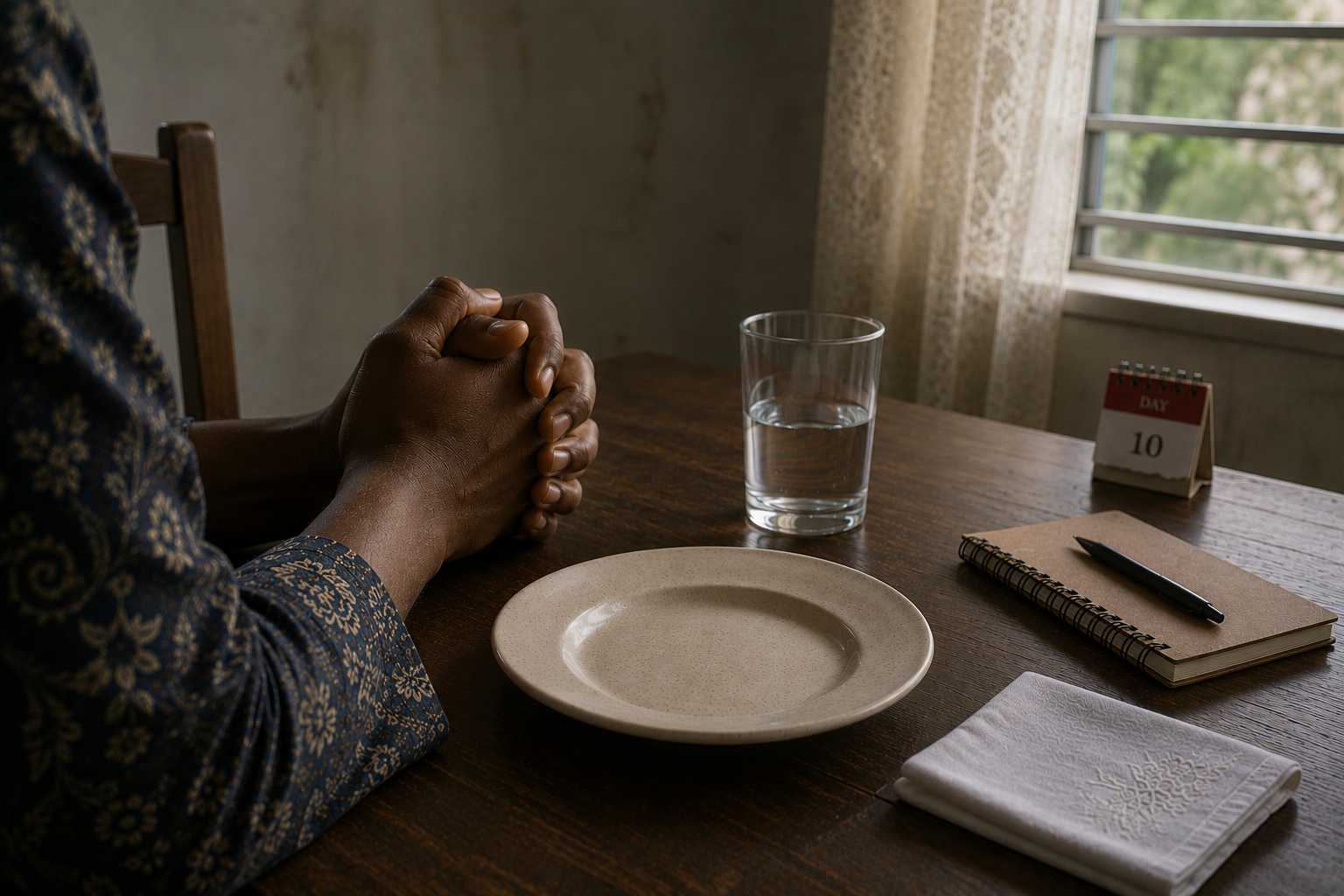
When Joy Owoyele’s husband abandoned her and their young daughter in 2014, she made desperate moves to have him back, including embarking on regular religious fasting and prayer for a spiritual solution.
For seven years, she would imagine him walking in saying, ‘I am sorry I left, please forgive me. I will make it right.’ That never happened in reality.
Instead, on day 10 of her 14-day prayer and fasting campaign at a Christ Apostolic Church branch in the Isheri Olofin area of Lagos, the 30-year-old collapsed on April 30, 2021. Doctors later confirmed her death at a hospital.
Medical experts say prolonged fasting without water and food can lead to severe dehydration and energy depletion, which can result in death.
What prolonged fasting does to the body
Glucose, a form of sugar derived from carbohydrates, is the source of energy that the body relies on to function. Extra glucose gained after meeting the body’s needs is stored in the liver and muscles.
During fasting, the body first uses the stored glucose for energy. Once those reserves are depleted, it begins breaking down fat for energy. If fasting continues for extended periods, especially without water, the body may begin to experience metabolic stress, reducing the body’s ability to efficiently produce energy and placing strains on vital organs.
“The human system is designed to adapt to short-term food restriction, but beyond a certain point, it begins to break down,” says Doctor Martins Alagh, a lecturer at the Benue State College of Health Science. “Blood sugar levels can drop dangerously low, leading to weakness, confusion, and in severe cases, loss of consciousness.”
Medical experts caution against prolonged fasting without proper hydration or medical supervision.
But it has many benefits
Fasting is generally recognised as enabling self-control, sharpening spiritual focus, and connecting one to the sacred. From Lent to Ramadan to extended prophetic fasts in Pentecostal circles, millions of people around the world willingly abstain from food and water for its spiritual and physical rewards.
On the physical side, A 2024 study published in the BMC Nutrition found that people who engage in intermittent fasting showed improvements in cardiovascular health, blood pressure, and memory compared to those who do not.
For many religious people like Ayodele Oluwafemi, a Muslim who works with Bolt, a mobility platform in Lagos, spiritual focus and benefits are the reasons he fasts.
“If I desire anything done that is beyond my power, maybe a promotion at work or anything at all that I know can only be gotten through spiritual intervention, I resort to fasting and praying,” he says.
In some religious settings, fasting is not just encouraged—it is expected, and breaking a fast prematurely may be seen as a lack of faith, spiritual weakness, or even disobedience.
Still, for whatever the reason one is fasting, moderation is advised. Health experts say prolonged fasting can increase health risks.
“We see a lot of emergencies during Ramadan and January church fasts. You see patients coming in unconscious, some convulsing because the brain couldn’t cope as a result of the prolonged starvation,” says Dr. Halima Sadiq, a general physician at the Garki General Hospital Abuja.
The risks are higher for people living with conditions like diabetes and peptic ulcers, as well as pregnant women. It can trigger complications such as energy and nutritional deficiencies. Prolonged water deprivation during fasting can place immense strain on the kidneys and heart, which can lead to sudden cardiac arrhythmia or renal failure.
‘Faith leaders should work with medical personnel’
Recognising the danger associated with prolonged fasting, some religious leaders now encourage moderation and advise people with critical health conditions to avoid fasting altogether.
“Fasting is not meant to kill the body,” says Samuel Adeyemi, a leader at Cherubim and Seraphin Church in Kogi State. “God does not require your life as proof of your faith. If someone is sick, elderly, or pregnant, they should be guided differently; such as allowing them to break earlier, drinking water at regular intervals or even avoiding the activity entirely depending on the case.”
In Kano State, Mallam Usman Zunurain, an imam, permits devotees with conditions that make them vulnerable to undertake alternative acts of devotion.
“For those who have terminal illnesses, or are well stricken in age, they are not allowed to fast. All they need to do daily is to make sure they feed one person daily. By doing so, they are covering up for the fast.”
Speaking from the Federal Medical Centre in Makurdi, Benue State, Doctor Daniel Aondona, a consultant family physician, proposes the need for faith leaders to work with medical personnel and integrate health education about fasting into their teachings.
With such a balance, he says there would be fewer emergency situations and more people would know when spiritual discipline becomes physically harmful.
The goal, experts say, is to ensure that spiritual devotion does not become a medical emergency. When the body’s warning signs are ignored in favor of a breakthrough, the results can be devastating.
Joy sought spiritual solutions through prolonged fasting. Instead, she died before the breakthrough she hoped for could arrive. Her story raises a critical question for faith communities about the line between devotion and danger.