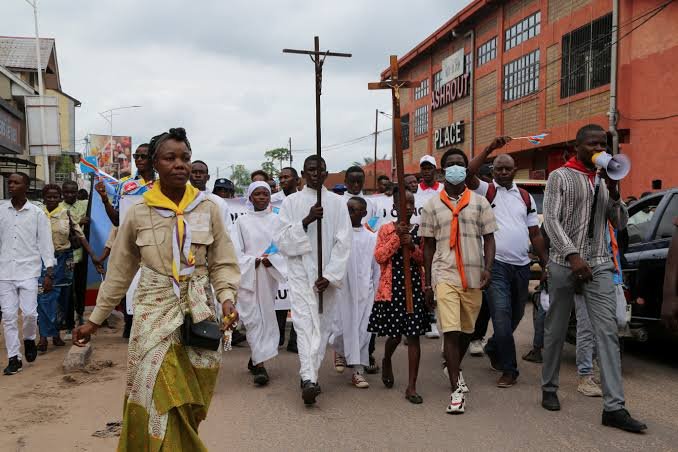
The Democratic Republic of the Congo (DR Congo) is projected to overtake the United States as the country with the world’s largest Christian population by 2070, according to new projections by the Pew Research Centre.
The projection is contained in a report titled The Future of World Religions: Population Growth Projections, 2020–2070, published on November 18.
According to the report, DR Congo’s Christian population is expected to rise from approximately 92 million in 2020 to 299 million by 2070, making it the country with the highest number of Christians globally.
The United States, which currently has the world’s largest Christian population, is projected to experience a decline from 217 million Christians in 2020 to 174 million by 2070.
Despite the decline, Christians are expected to remain the largest religious group in the US, although they will no longer constitute a majority of the country’s population.
Pew attributed the projected growth in DR Congo partly to its high fertility rate, which stood at 6.1 children per woman between 2020 and 2025, compared with 1.6 in the United States.
The report also projected that sub-Saharan Africa would become home to 54 per cent of the world’s Christian population by 2070, up from 31 per cent in 2020.
It estimated that the number of Christians in the region would increase by 896 million over the 50-year period, while the rest of the world would record a decline of about 210 million.
Globally, Christianity is projected to grow by approximately 687 million people to nearly three billion by 2070. However, its share of the world’s population is expected to remain around 29 per cent.
The projections form part of a broader study examining changes in the populations of seven religious groups across 201 countries and territories.
Pew said its projections are based on existing patterns of fertility, mortality, migration and religious switching, while noting that changes in these factors could affect future outcomes.