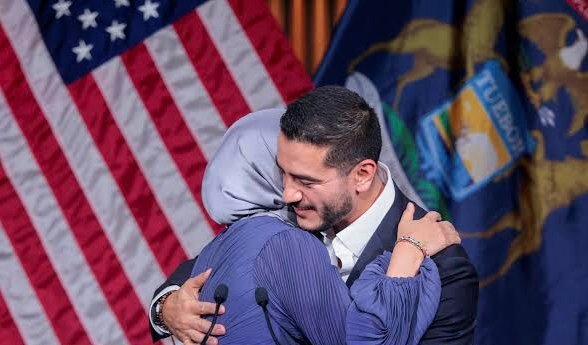
At least seven Muslim candidates have won seats in the United States Congress following the November 3 midterm elections, marking the highest number of Muslim lawmakers elected to the country’s federal legislature.
The victories include Abdul El-Sayed, who became the first Muslim elected to the US Senate, alongside six Muslim candidates who secured seats in the House of Representatives.
El-Sayed, a 42-year-old Democrat from Michigan and former public health official, defeated Republican candidate Mike Rogers in a closely watched contest for the Senate seat vacated by retiring Senator Gary Peters.
His victory came after a campaign in which his Muslim identity became a major issue, with President Donald Trump and other Republican figures making accusations against him that were not supported by evidence.
Fatima Salman, a childhood friend of El-Sayed who supported his campaign, described the outcome as a moment of celebration for Muslim Americans.
“Islamophobia backfired,” she said.
Four Muslim Democrats who already served in the House also won re-election.
They include André Carson, who represents Indiana’s 7th Congressional District; Ilhan Omar of Minnesota’s 5th District; Rashida Tlaib of Michigan’s 12th District; and Lateefah Simon of California’s 12th District.
Two other Muslim Democrats, Adam Hamawy of New Jersey and Darializa Avila Chevalier of New York, won congressional seats for the first time.
Hamawy, a physician and former US Army combat doctor, won New Jersey’s 12th Congressional District, becoming the first Muslim elected to represent the state in Congress.
During his victory speech, Hamawy condemned anti-Muslim rhetoric and ended his address with “Allahu Akbar,” an Arabic expression meaning “God is greatest.”
He said the phrase, which some political figures have attempted to associate with fear, represented humility and gratitude in his faith.
Avila Chevalier, a 33-year-old Democrat and convert to Islam, also made history as the first Latina Muslim elected to Congress.
The daughter of Dominican immigrants, she won New York’s 13th Congressional District after defeating longtime incumbent Adriano Espaillat in the Democratic primary.
Her election further expanded the diversity of Muslim representation in the US legislature.
The victories came amid growing concerns over anti-Muslim rhetoric in American politics.
Mohamed Gula, chief executive officer of Emgage, a Muslim civic engagement organisation, said Muslim Americans had increasingly turned to electoral participation to challenge discrimination and strengthen their representation.
He said the election results demonstrated a growing sense of belonging among Muslim voters and their allies.
Before the latest elections, the highest number of Muslims serving in Congress simultaneously was five.
Keith Ellison, a Democrat from Minnesota, became the first Muslim elected to Congress in 2006. He later left the House after winning election as Minnesota’s attorney general in 2018.
Meanwhile, Muslim candidate Aisha Wahab was leading in California’s 14th Congressional District as vote counting continued. If her victory is confirmed, the number of Muslim lawmakers elected to Congress could rise to eight.
The Council on American-Islamic Relations (CAIR), a Muslim civil rights organisation, said more than 160 Muslim Americans were running for local, state and federal offices in the 2026 elections, compared with 145 in 2022.