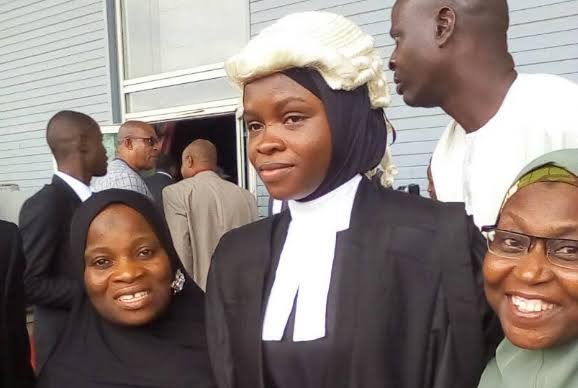
A Nigerian Muslim lawyer, Firdausa Amasa, has called on the management of the Nigerian Law School to intervene after some Muslim female candidates were allegedly harassed over their hijabs during the ongoing 2026 Bar Final examinations in Abuja.
Amasa, who previously challenged restrictions on wearing hijab during the Call to Bar ceremony, said two female candidates were seen crying after examination officials allegedly forced them to remove and rewrap their head coverings like turbans at the institution’s Bwari campus.
In an incident report dated Saturday, October 31, 2026, Amasa said she visited the campus to monitor compliance with a circular permitting candidates to write their Bar Part II examinations wearing hijab.
She said she inspected five examination halls and observed that candidates wearing hijab were admitted without hindrance in four of them.
However, she reported that female candidates encountered restrictions at the Main Hall, also known as the Multipurpose Hall, where they were allegedly stopped at the entrance and instructed to remove their hijabs and rewrap them in a turban-like manner before gaining access.
“I personally witnessed two female candidates crying at the entrance as a result of this harassment,” she said.
According to Amasa, the incident caused distress among the candidates shortly before they were due to sit for their examinations.
She described the actions of the examination supervisors as unlawful, arguing that they contradicted the Law School’s circular and constitutional provisions protecting religious freedom.
Amasa cited Sections 38(1) and (2) of the 1999 Constitution, which guarantee freedom of thought, conscience and religion, including the right to manifest and practise one’s religion.
She also referenced a 2022 Supreme Court judgment in Lagos State Government & Others v. Asiyat Abdulkareem, which affirmed the right of Muslim female students to wear hijab in public schools.
The lawyer further cited Section 42 of the Constitution, which prohibits discrimination, and Section 34, which guarantees the dignity of the human person.
She warned that publicly harassing candidates over their religious attire could affect their psychological well-being, concentration and examination performance.
Amasa urged the Nigerian Law School management to call the supervisors at the Multipurpose Hall to order and ensure that the directive permitting hijab was consistently implemented across all examination centres.
She also requested that clear instructions be issued to all examination officials to prevent further incidents and guarantee that no candidate would be disadvantaged for wearing hijab.
While acknowledging the Law School’s decision to issue a circular permitting hijab, she said its inconsistent implementation undermined the directive.
“This must be stopped immediately,” she said.
Amasa’s previous hijab controversy
The latest development recalls Amasa’s experience in December 2017, when she was prevented from attending her Call to Bar ceremony at the International Conference Centre in Abuja because she refused to remove her hijab.
The incident generated nationwide controversy, with Muslim organisations, lawyers and other stakeholders questioning the decision and demanding respect for religious freedom.
Following the controversy, the Body of Benchers approved her participation in the ceremony in June 2018.
She was subsequently called to the Nigerian Bar on July 10, 2018, wearing her hijab.
Her experience became a significant reference point in campaigns advocating the rights of Muslim women to wear hijab in educational and professional institutions.
The latest allegations come amid renewed concerns from Muslim organisations over restrictions reportedly faced by female Muslim candidates during the 2026 Bar examinations.
The Nigerian Law School had yet to issue an official response to Amasa’s incident report at the time of this publication.