
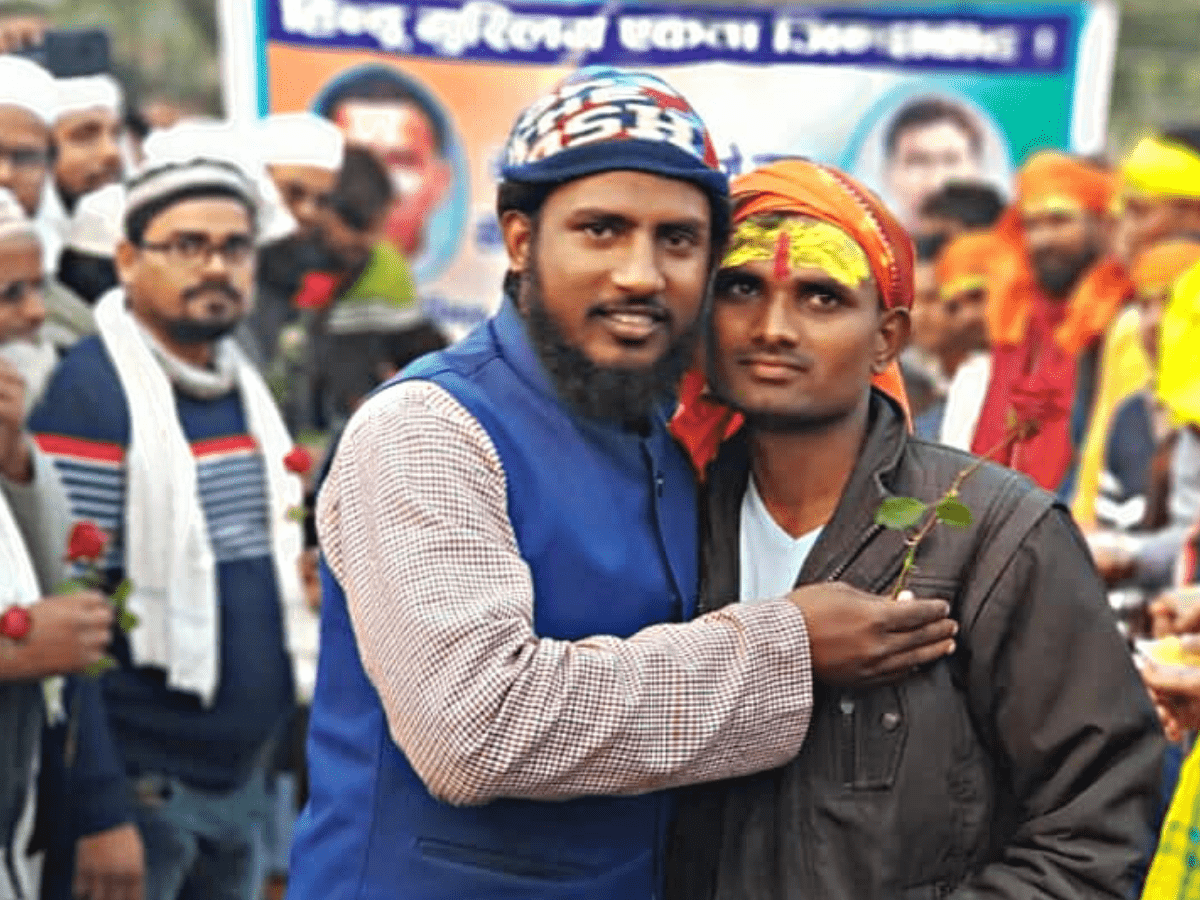
Muslim, Sikh and Hindu communities in India’s Punjab state are working together to rebuild mosques abandoned or damaged during the 1947 partition of British India, with non-Muslim residents donating land, money and building materials to provide Muslims with places of worship.
The initiative has supported the construction or restoration of more than 165 mosques over the past nine years, according to a report by The Guardian.
In Jakhiwal village, Fatehgarh Sahib district, an 87-year-old Muslim resident, Gajju Khan, hopes to hear the Muslim call to prayer, known as the azaan, in his village again when a mosque under construction is completed.
The mosque is being funded almost entirely by Sikh and Hindu residents to serve the village’s 18 Muslim families.
Khan recalled that Sikh neighbours sheltered him and his two brothers during the communal violence that followed the partition in 1947, although his parents were killed in their home village.
He said his parents had sent the children away to escape the violence.
Khan expressed gratitude to Bibi Rajinder Kaur, a 77-year-old Sikh resident who persuaded her grandson to donate part of their family farmland for the mosque.
Kaur said she supported the project because other religious communities had places to worship, while local Muslims did not.
“There is no deed better than giving someone a place to worship,” she said.
She also noted that Muslims in the village previously had to travel about four kilometres to another community to pray.
Hindu family donates land for mosque
In Punawal village, Sangrur district, a 48-year-old man from a Hindu priestly family, Jaspal Sharma, donated land for the construction of a mosque.
The village has about 550 households, with Muslims making up a small proportion of the population.
Sharma said residents from different religious backgrounds contributed to the project, with some donating money and others providing construction materials, including bricks and cement.
He also hosted a feast for the village when the mosque was inaugurated in February.
Sharma described the donation as a responsibility towards his neighbours, adding that he welcomed the sound of Muslim prayers from the mosque opposite his home.
Residents work across religious boundaries
Efforts were made to restore a local shrine in Umarpura village, Malerkotla, by Sikh brothers Sukhjinder Singh Pandher and his brother.
Pandher said residents of different faiths maintained close relationships, celebrating festivals such as Eid and Gurpurab together.
He said the community continued to value peaceful coexistence despite religious divisions elsewhere in the country.
Pandher also linked the initiative to Punjab’s history of cultural exchange and religious traditions.
Partition left mosques abandoned
The 1947 partition divided British India into India and Pakistan, triggering widespread communal violence and the displacement of millions of people.
The violence and mass migration left many mosques on the Indian side of Punjab abandoned, damaged or converted to other uses as much of the region’s Muslim population moved to Pakistan.
Over the past decade, Sikh and Hindu communities in several rural areas have supported efforts to restore old mosques or build new ones for Muslim residents.
The initiative was encouraged by Maulana Habib-ur-Rehman Sani Ludhianvi, a former chief imam of Punjab.
His successor, Maulana Muhammad Usman Rehmani Ludhianvi, said the partition had damaged the region’s social relationships but that ordinary residents continued to protect one another despite growing polarisation online.
“Online, there is immense polarisation, but on the ground in our villages, ordinary people are still choosing to protect each other,” he said.
Similar efforts to strengthen relationships between religious communities have also featured in Nigeria, where the Nigerian Supreme Council for Islamic Affairs called for stronger Muslim-Christian cooperation