
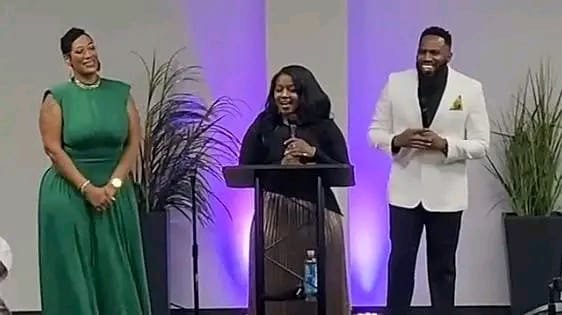
Prophet Israel Ford, a US-based pastor has defended polygamy after introducing his second wife to his church congregation. He argued that the biblical requirement that a church leader be “the husband of one wife” is cultural and should not be interpreted as a universal restriction on marriage.
Ford, who leads LifeWorks Church alongside his first wife, Pastor Lydia Ford, in Ohio, made the remarks while responding to criticism over his marriage to a second woman, Shakayla.
The controversy over his choice of polygamy followed a church service on October 25, 2026, during which Lydia publicly introduced Shakayla as her husband’s second wife, describing her as her “sister in marriage.”
Ford subsequently announced the marriage on social media, declaring that the teaching that a man should have only one wife was “unbiblical” and promising to explain his position in a sermon.
Responding to objections based on the biblical requirement that church leaders be the husband of one wife, Ford argued that the instruction was directed at specific leadership positions rather than every Christian.
“One, I’m not a bishop nor am I a deacon. Two, if that’s actually what that meant, then that would only pertain to those who are on that level of leadership,” he said.
He argued that many Christians interpreted the passage as a universal prohibition because of how they had been taught to understand Scripture.
Ford also drew a comparison with biblical instructions concerning women’s participation in church gatherings, arguing that some passages should be understood within their historical and cultural contexts.
“And once I got that understanding, I was able to even go to the chapter before in chapter two where it says women should be silent in the church. Well, I was able to get over that one. And I knew that that was a cultural thing. So why can we not get over the other one, which is a bishop? It’s cultural,” he said.
According to Ford, critics often dismiss his interpretation as an attempt to justify his personal choices, making him reluctant to continue explaining his position to people who have already made up their mind.
Backing her husband, Lydia said the arrangement was not new and described Shakayla as a woman whom church members already knew through her ministry. Shakayla also addressed the congregation, saying she had not been disadvantaged by the arrangement and describing it as a family relationship in which the women supported one another.
Ford later disclosed that he and Shakayla had been married for nearly three years before the relationship was publicly announced. The announcement generated mixed reactions online, with some social media users questioning whether the arrangement aligned with biblical teachings on marriage, while others defended the family’s interpretation of Scripture.
Ford’s argument has reignited debate over the interpretation of biblical passages concerning marriage and the qualifications expected of Christian leaders.
Ford’s position places him at the centre of this longstanding theological disagreement, particularly over whether biblical instructions should be applied universally or interpreted in their historical and cultural contexts.
Beyond the theological debate, polygamy also raises legal questions in the United States, where state laws prohibit bigamy. In Ohio, where Ford’s church is based, the law criminalises certain acts involving marriage to, or cohabitation with, multiple spouses. The public announcement alone does not establish the legal status of Ford’s reported marriages.
Ford has indicated that he intends to explain his interpretation of Scripture further, as the debate over his marriage continues to generate reactions among Christians and social media users.