
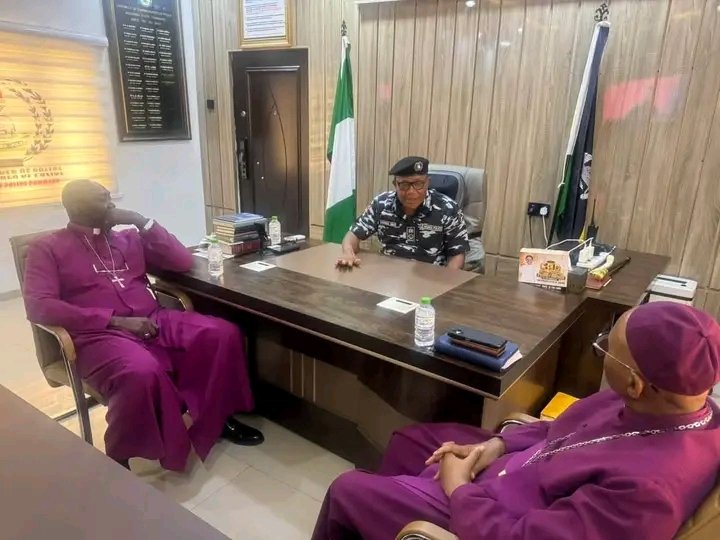
The Anambra State Police Command has held a peace meeting with rival leaders of the Anglican Communion in Awka over an escalating leadership dispute, urging them to seek a resolution through the church’s established hierarchy while respecting ongoing court proceedings.
The Commissioner of Police, Nnanna Oji Ama, met with the parties involved in the dispute at the command’s headquarters in Awka on Friday, October 23, as part of efforts to prevent the crisis from escalating into a breakdown of law and order.
The police spokesperson, Tochukwu Ikenga, disclosed this in a statement, saying the commissioner urged the parties to exercise restraint and avoid actions capable of heightening tensions. According to the statement, Ama acknowledged the ongoing court proceedings relating to the dispute and emphasised the need for all parties to respect the judicial process.
He also encouraged the church leaders to pursue peaceful dialogue and explore appropriate channels within the Anglican Communion’s established ecclesiastical hierarchy to resolve their differences without prejudicing the cases before the courts.
The commissioner warned against inflammatory statements and confrontational conduct, stressing that parishioners and worshippers should not be drawn into disagreements among church leaders or made to suffer the consequences.
He reaffirmed the command’s impartiality, assuring the parties that the police would address legitimate security concerns, respect the authority of the courts and protect the rights of everyone involved. The command also warned that it would take appropriate lawful measures to prevent any breach of public peace.
Background
There has been a leadership crisis in the Anglican Diocese of Awka following the decision of the Primate of the Church of Nigeria (Anglican Communion), Henry Ndukuba, to direct the Archbishop of the Province of the Niger and Bishop of Awka Diocese, Alexander Ibezim, to proceed on six months’ compulsory leave, as reported by Religion Journalism Foundation.
In a letter dated October 13, Ndukuba said the directive followed reports from administrative panels investigating developments in the diocese, including findings from a visitation team led by the church’s Dean.
The Primate said the leave was intended to facilitate a thorough investigation, restore peace and promote reconciliation within the diocese. He subsequently appointed the Bishop of Aguata Diocese, Samuel Ezeofor, as Supervising Bishop of Awka Diocese and Coordinating Bishop of the Province of the Niger during Ibezim’s absence.
However, the Awka Diocesan Board rejected both the compulsory leave directive and Ezeofor’s appointment at an emergency meeting on October 16. The board challenged the Primate’s authority to impose the leave and transfer Ibezim’s responsibilities to another bishop, maintaining that the decision was unacceptable. It also passed a vote of confidence in Ibezim and directed diocesan organs to continue recognising his leadership.
The board further threatened that the diocese could consider withdrawing from the Church of Nigeria and rejoining the Church of England if the disputed decisions were not reversed. The disagreement has also resulted in court proceedings involving the church leaders.
The latest intervention follows an earlier clarification by the police command after officers were deployed to St. Faith’s Anglican Church in Awka during a service conducted by Ibezim despite the Primate’s directive.
The command had denied taking sides in the dispute, explaining that police deployments were intended to maintain law and order, protect lives and property, and prevent a breakdown of peace.
In its latest statement, the command called on church leaders, parishioners and other stakeholders to cooperate with peace efforts, respect due process and refrain from conduct capable of turning the ecclesiastical disagreement into a security challenge.
The police maintained that the dispute should be managed peacefully without compromising public order or the rights of the parties involved.