
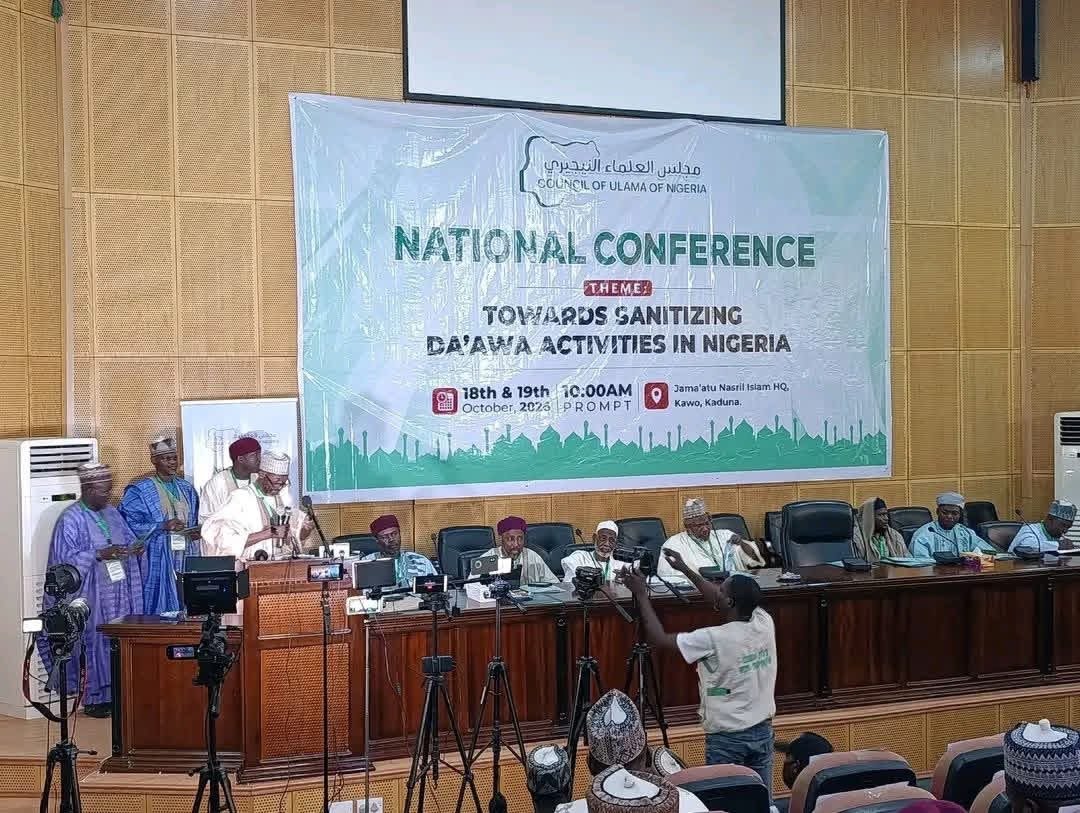
Islamic scholars in Nigeria have been urged to avoid preaching that promotes hatred and division among Muslims, as religious leaders called for greater unity and stronger government action against insecurity and poor governance.
The call was made at the council’s 2026 annual conference, themed “Towards sanitising da’awa activities in Nigeria,” held at the headquarters of Jama’atu Nasril Islam (JNI) in Kaduna. The conference also addressed insecurity, governance, poverty and declining moral values in the country.
The Sultan of Sokoto, Alhaji Sa’ad Abubakar III, urged Islamic scholars to uphold the teachings of Islam and promote harmony among Muslims in a message delivered by the Secretary-General of JNI, Sheikh Khalid Aliyu.
He cautioned against preaching that encourages hatred, saying such conduct could reflect an inadequate understanding of the Qur’an and Islamic teachings.
The conference brought together religious leaders and political figures to discuss challenges facing Nigerian society, including insecurity, poverty, governance and declining moral values.
Scholars demand action on insecurity
The National Secretary of the Council of Ulama in Nigeria, Professor Muhammad Sadiq Abubakar, called on the Federal Government to strengthen its response to insecurity by engaging security chiefs, setting clear performance targets and holding them accountable for results.
He acknowledged government efforts to address insecurity but said more decisive measures were needed to end persistent violence.
His remarks placed responsibility on government institutions to demonstrate measurable progress in protecting lives and property.
Poor budget implementation linked to poverty
In a paper titled Islamic Perspective on the Present Political Dispensation, Dr Usman Muhammad Bugaje attributed rising poverty, insecurity and declining moral values partly to poor or irregular budget implementation.
He said delays in implementing the previous year’s budget had affected development and prevented Nigerians from receiving the expected benefits of government spending.
Bugaje also urged Muslim leaders to participate actively in democratic processes, drawing on Qur’anic principles of leadership to promote justice, accountability and citizens’ welfare.
Atiku warns against political bias
Former Vice-President Atiku Abubakar urged Islamic scholars to examine their own conduct while addressing social challenges.
Represented by the African Democratic Congress governorship candidate in Kaduna State, Alhaji Isa Ashiru Kudan, he called on religious leaders to promote moral values and social responsibility.
Atiku also cautioned them against openly supporting particular political candidates, urging them to remain fair and ensure that resolutions adopted at the conference were implemented.
Kaduna State Governor Uba Sani, represented by the Director-General of Interreligious Affairs, Mallam Tahir Umar Tahir, also expressed concern about declining mutual respect among religious leaders.
He said some had resorted to disparaging one another for personal reasons, warning that such conduct could undermine unity and peaceful coexistence.
The governor urged religious leaders to work together to promote harmony and contribute to national development. He also pledged his administration’s support for initiatives promoting religious activities and peaceful coexistence in Kaduna State.